


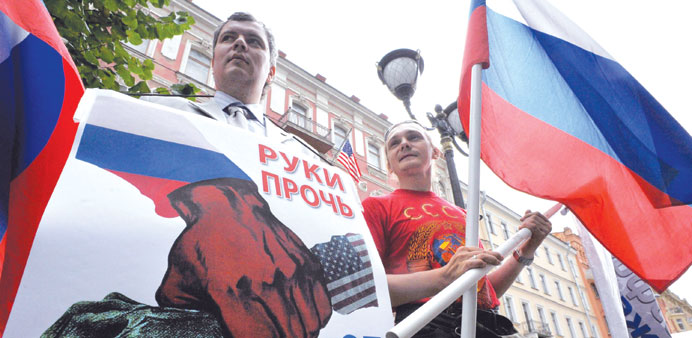
Pro-Kremlin activists picket the US Consulate in St Petersburg to condemn the US-led plans for military action in Syria against the regime of Bashar al-Assad. The poster reads: “Hands off Syria!”
Reuters/Paris
Senior members of France’s ruling party rebuffed opposition calls for a parliamentary vote on whether to take military action against Syria, saying yesterday lawmakers should respect the president’s constitutional right to decide on attacks.
President Francois Hollande’s demands for Syrian President Bashar al-Assad to be punished for an alleged chemical strike have left him out on a limb since Britain’s parliament voted against taking part in any action and US President Barack Obama said he would seek Congress approval before any assault.
Hollande is the army’s commander in chief under the French constitution and empowered to order an intervention. His sole obligation is to inform parliament within three days of action starting. Only if it were to last more than four months would he be obliged to seek parliamentary approval for it to continue.
With opinion polls showing up to two-thirds of the public would oppose an intervention in Syria, several conservative, centrist and green politicians called over the weekend for France to hold a special parliamentary vote.
Health and Social Affairs Minister Marisol Touraine told Reuters there was no reason to do that. “There is a framework and we must respect it,” she said. “The issue is too serious to be opened up to political posturing.”
“In a complicated situation like this, we need to stick to principles, in other words the constitution, which does not oblige the president to hold a vote, nor even a debate,” foreign affairs committee chief Elisabeth Guigou, a veteran of the ruling Socialist Party, told France Info radio.
“I don’t see that holding a vote would make any sense politically,” she said, noting France would be left in an impossible situation if parliament voted in favour of action and then the US Congress voted against.
Interior Minister Manuel Valls also said over the weekend that the constitution should be respected.
But Alain Juppe, foreign minister under conservative ex-president Nicolas Sarkozy, said a vote was needed because the UN Security Council had not backed any attack on Syria. “We’re in a specific context here ... It would justify a vote in parliament,” he said.
Parliament is due to debate the Syria crisis today.
The last time parliament voted on military action was in 1991 when then-Socialist president Francois Mitterrand sought its support for his decision to join the US-led coalition in the Gulf War.
Guigou said doing nothing would signal to all authoritarian rulers that using chemical weapons against civilians can go unpunished. She acknowledged France would not act on its own.
“To give an intervention legality it would need to be carried out by a broad coalition,” she said.
Prime Minister Jean-Marc Ayrault told reporters he would show parliament leaders evidence in a meeting proving that Assad’s forces used chemical weapons” on in an attack on August 21 that Washington says killed over 1,400 people.
A declassified French intelligence document published by the weekly Le Journal du Dimanche and confirmed as authentic by a government official said Syria’s chemical weapons arsenal included sarin, VX nerve agent and mustard gas.
A BVA opinion poll released on Saturday showed 64% of respondents opposed taking military action in Syria, 58% did not trust Hollande to conduct an operation and 35% feared that strikes could set the Middle East “ablaze”.
Russian MPs want to travel to Washington, seek to sway US Congress vote on Syria
Russian lawmakers want to travel to Washington to urge the US Congress not to back President Barack Obama’s plan for military strikes on Syria, the speaker of the upper house of parliament told President Vladimir Putin yesterday in the resort town of Novo-Ogaryovo.
Dismissing US accusations that the Syrian government had killed hundreds of its own people with poison gas as nothing but “talk”, senior legislator Valentina Matviyenko said both chambers were ready to send delegations.
“I think if we manage to establish a dialogue with our partners in the US Congress, to exchange arguments, we could possibly better understand each other,” Matviyenko, speaker of the Federation Council, told Putin at his residence near Moscow.
“We hope that the US Congress will occupy a balanced position in the end and without strong arguments in place ... will not support the proposal on use of force in Syria,” Matviyenko added.
It was uncertain what sort of reception a Russian delegation would receive in the US. Both countries passed legislation last year to punish the other for alleged human rights violations. Moscow has also defied Washington by granting temporary asylum to former US spy agency contractor Edward Snowden.