


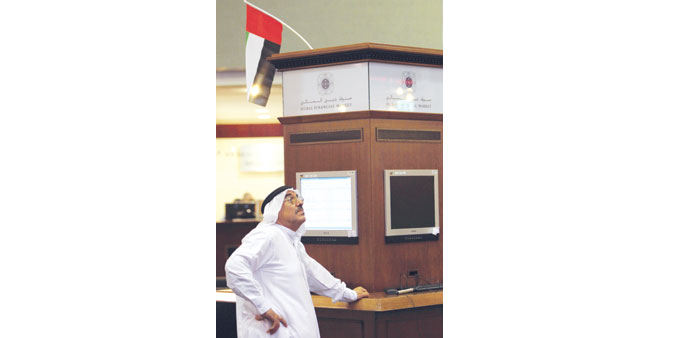
Reuters/Dubai
Dubai’s bourse led a regional recovery in shares yesterday after US President Barack Obama delayed a military strike against Syria, saying he will seek congressional consent.
Dubai’s index rose 3%, partly recouping losses from last week’s heavy retail-driven sell-off. The market is dominated by short-term, momentum traders who have knee-jerk reaction to political concerns. It is still 150 points away from the five-year peak hit on August 25.
“Dubai rebound from a sell-off today but you’ll see a lot of indecisiveness until Congress vote on Syria,” said Ahmed Shehada, head of trading at QNB Financial Services. “It’s smart to reduce risk at this point for the short-term but not completely exit the market.”
Abu Dhabi’s measure rose 1.8%, snapping four sessions of losses.
“Confidence is reinstated in the market but we’ll have to wait till next week for a clearer direction going forward,” Shehada added.
The US released evidence the Syrian government used chemical weapons to attack civilians and said President Bashar al-Assad regime should not go unpunished.
US House of Representatives Speaker John Boehner plans to hold a congressional debate on the matter in the week starting September 9. Any strike, after a congressional vote, would be in mid-September at the earliest.
Ali Adou, portfolio manager at The National Investor said the rally is likely to be short-lived. “The risk will go back up after congress meetings next week.”
British Prime Minister David Cameron lost a parliamentary vote late on Thursday that ruled out its involvement in military action against Syria. French President Francois Hollande is under increasing pressure to also seek a parliamentary vote.
In Saudi Arabia, the measure climbed 1.5%, heading for its third gain following a 654-points correction early last-week.
There is little direct impact expected in Gulf countries from a strike on Syria, but Saudi Arabia raised its level of military alertness, sources told Reuters on Friday.
“Since the expectation for action this week has been definitely postponed, the markets this week will have a relief rally,” said John Sfakianakis, chief investment strategist at Saudi investment firm MASIC. “You’ll see additional liquidity to buy in stocks that are at relatively good entry points compared to what they were prior to last week’s correction.”
Petrochemical shares supported the rally - the sector’s index rose 1.3%. Higher oil prices boosted sentiment on the sector; Brent crude made its biggest monthly gain in a year for August.
Saudi petrochemical stocks tend to track oil prices, with crude impacting their bottom line.
Cairo’s benchmark index climbed 0.6%, trimming 2013 losses to 3%. Renewed street violence dampened investor sentiment.
Bluechip Commercial International Bank added 0.5%, but losers outnumbered gainers 17 to seven.
Shares in EFG-Hermes slipped 0.6% after the investment firm posted a second-quarter net loss of 29mn Egyptian pounds ($4.15mn).
Elsewhere in the Gulf, Kuwait’s index slipped 0.1% to 7,623 points; Oman’s benchmark rose 0.7% to 6,736 points, while Bahrain’s measure eased 0.02% to 1,188 points.