


DPA/Kabul
The German guitarist struck a series of perfect notes against the Afghan master musicians, following them closely.
The three percussionists - two Afghans on traditional tabla and dhol, and a German on drums - played off against each other and then together, while the German double bassist filled in solos.
The oldest of the crew, Ustad Amruddin, an Afghan in his seventies, played heart-wrenching music on the dilruba - a kind of harp - as if he was in his youth.
The tunes and beats of the musical ensemble - five Afghans and three Germans - lifted the ecstatic audience on Tuesday evening at a concert held at the historic Babur Garden in Kabul, a rare event in a country dogged by violence and conflict.
It was part of a concert tour titled Safar (Journey), which aims to bring traditional Afghan music to an international audience.
In the one-and-a-half hour show, the Afghan musicians, backed by the Germans, played several compositions, including the popular song Love You Raja from the 1995 Indian movie Raja.
Last year, the group gave four sold-out concerts in Germany.
Amid tight security with sniffer dogs and private guards, the Kabul concert was attended by some 500 people, including high-level Afghan officials, ambassadors and expats.
Thousands of others watched it streamed online.
Under the Taliban regime from 1996 to 2001, all forms of music were completely forbidden and many musicians, including those playing on Tuesday, were driven out of the country.
For Philip Kuppers, the main brain behind the project, it started as a quest to find out what happened to the traditional Afghan music scene after the fall of the Taliban.
Kuppers, an ethno-musicologist at Germany’s Liszt School of Music in Weimar, and Ahmad Sarmast, the director of the Afghanistan National Institute of Music - the country’s only institution of its kind - decided to organise a collaboration between musicians from the two countries in an effort to increase inter-cultural understanding.
“With the Safar project we want to draw international attention to the cultural wealth of Afghanistan, whose image is shaped today unfortunately by terrorism and war,” Kuppers said.
Sarmast said the concerts bring Afghans together, help them enjoy “the beauty of music,” and to forget “the miseries of 30 years of war.”
“Such opportunities enable Afghan people to learn various styles of music, to get closer to people with various backgrounds, various styles of music, and enjoy it,” Sarmast said after the concert.
“The idea behind these kinds of collaborations is the strong belief in the soft power of music.”
Music in Afghanistan is mostly confined to a few areas as a form of art, said Sarmast, who wants to use music to reflect on the positive changes in the country.
Kuppers says he is also interested in the cultural diplomacy of music.
“There are a lot of interesting inter-relations between music and politics, whether it was during the Soviet regime or the Taliban.”
But more interesting is the fact that Afghanistan is a melting pot of different kinds of music, with influences from India and Pakistan as well as the former Turkish and Persian empires, Kuppers said.
“Afghanistan has a huge variety of different traditional music... which is impressive and unique,” he said.
“There is no country in the world where music does not play an important role for the identity of its people.”
The Safar project is funded by the German Ministry of Foreign Affairs. As well as holding concerts, music is recorded and documented for future generations.
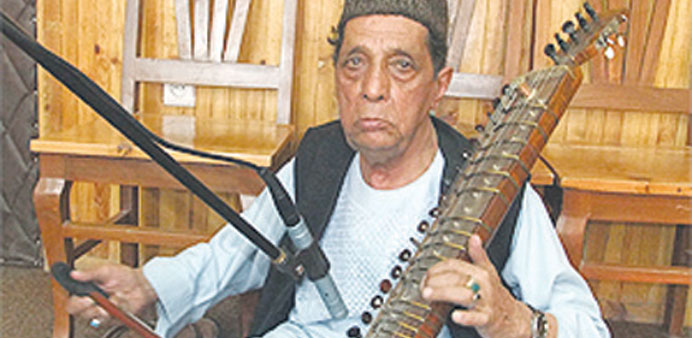
Ustad Amruddin plays the dilruba.