


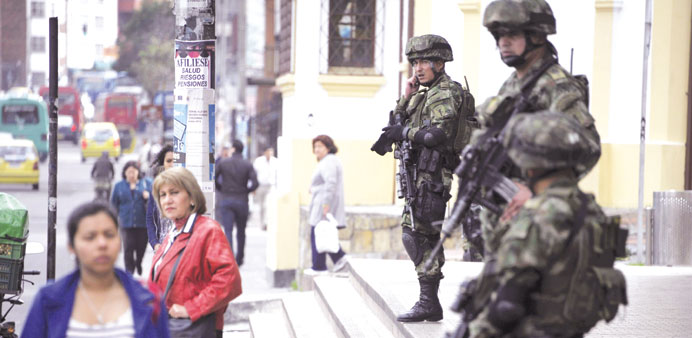
Colombian soldiers patrol a street in Bogota yesterday. President Juan Manuel Santos ordered troops to provide security in the country’s capital and patrol Colombia’s highways after 12 days of violent protests spread from rural areas.
President Juan Manuel Santos ordered troops to patrol Bogota and Colombia’s highways yesterday, after violent protests in support of striking farmworkers left two dead.
“I have ordered the militarisation of Bogota in any municipality or area that needs the presence of our soldiers,” he said in a speech broadcast on radio and television.
Santos said he had ordered the deployment of up to 50,000 troops on the nation’s highways, which have been targeted with protests and blockages by striking farmworkers since August 19.
Santos said two people were killed on Thursday in Bogota when demonstrators mounted large marches that ended in violent clashes with police.
The demonstrations in Bogota marked the first time that the farmworkers’ rural protests had spread to the capital and other cities.
Santo’s defence minister on Thursday accused leftist FARC guerrillas of infiltrating the marches to sow violence.
Santos made no mention of the FARC, with whom his government is holding peace talks in Havana, instead blaming a leftist group called Patriotic March.
“The Patriotic March movement only seeks to take us to a situation with no way out to impose its own agenda. It doesn’t care at all about the farmworkers,” he said. “I have said you’re welcome to protest, but not protests at gunpoint or with threats,” he said.
A spokesman for the Bogota mayor’s office said soldiers would patrol the city “in co-ordination with the police.” Santos said the military would work with the police nationwide “to help with the mobility of our highways.”
The air force was ordered to make its fleet of transport planes available to fly food and other essentials into the capital if necessary, he said.
Farmers, hit by rising costs and competition from imports, are demanding increased agricultural subsidies and other relief. Miners, truck drivers, students and workers have joined the protests, each with their own set of grievances.
On Thursday, Santos acknowledged that farmers have been facing hard times, and promised price controls on fertiliser and pesticides. But in his speech yesterday, the Colombian leader said he had recalled his government’s representatives from negotiations that had been underway with protest leaders in the city of Tunja, 150kms from Bogota. “We maintain all our willingness to dialogue with the real farmworkers,” he said.