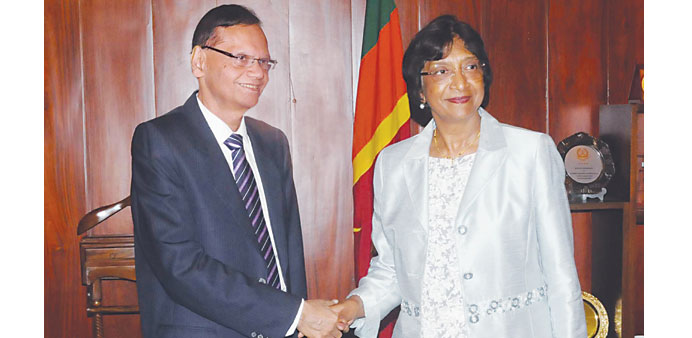
SMILE FOR THE CAMERA: This handout photograph released by Sri Lanka’s ministry of external affairs shows Foreign Minister Peiris with visiting UN human rights chief Pillay in Colombo yesterday.
Reuters/Colombo
A Sri Lankan minister has accused UN Rights Commissioner Navi Pillay of acting without transparency in evaluating the country four years after the end of its civil war and said her report would be unfair.
A UN panel has said that it has “credible allegations” that Sri Lankan troops and rebels both committed atrocities and war crimes during the 26-year conflict, and singled out the government for most of the blame.
Amid protests for and against a seven-day visit to assess human rights, Pillay visited former northern war zones in Jaffna, Kilinochchi, Mullaitivu and Trincomalee in the east.
Housing Minister Wimal Weerawansa, leader of the National Freedom Front, a hardline nationalist party in President Mahinda Rajapakse’s coalition, criticised Pillay’s itinerary.
“There is a problem about whether she is working with transparency,” Weerawansa told reporters in Colombo. “In Trincomalee yesterday, she secretly met some people who were not in the normal schedule. She is also scheduled to meet some people who are critical of the country. So our view is, she is not going to submit a fair report (to the UN).”
Government spokesman Keheliya Rambukwella said that Pillay had freedom to meet whomever she chose during her visit. Her visit will end tomorrow with a news conference.
External Affairs Minister G L Peiris met Pillay yesterday and told her that Colombo would accept “constructive and justified criticism” but rejects “vicious and baseless positions which are incessantly repeated”, Peiris’s ministry said.
Pillay’s spokesman Rupert Colville said that she was doing what human rights high commissioners always do on such missions.
“They talk to a wide range of people and collect a variety of views on human rights issues in the country in question,” Colville told Reuters in an e-mailed statement.
Pillay’s visit followed a second US-sponsored UN resolution in March this year that urged Sri Lanka to carry out credible investigations into killings and disappearances during the war, especially in the final stages.
The Sri Lanka government battled separatist Tamil guerrillas from 1983 until 2009.