


AFP/London
Asian markets fell sharply yesterday, while oil prices rose and emerging market currencies sank, as the West stepped up preparations for a possible military strike on Syria.
The losses extended falls on Tuesday and followed drops on Wall Street and in Europe as investors ran for cover, while stocks and currencies in developing Asian countries came under renewed pressure.
Adding to the tensions in the Middle East are concerns about a looming row in Washington over the US debt ceiling, which could leave the country in political deadlock.
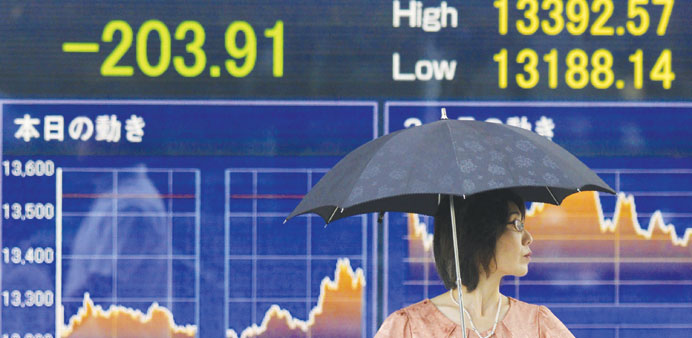
Tokyo tumbled 1.51%, or 203.91 points, to 13,338.46 and Sydney shed 1.05%, or 54.0 points, to close at 5,087.2.
Seoul clawed back some early losses to end flat, edging down 1.32 points to 1,884.52.
Shanghai was off 0.11%, or 2.27 points, at 2,101.30 while Hong Kong ended at a five-week low, slipping 1.60%, or 350.12 points, to 21,524.65.
Emerging markets in Asia—already seeing selling because of the expected wind-down of the US Federal Reserve’s massive stimulus programme—were mostly lower.
Jakarta closed 1.48% higher, but Kuala Lumpur was off 0.89% and Bangkok lost 1.41%.
Manila ended down 3.02%, or 178.93 points, at 5,738.06 as traders grew jittery before the release of economic growth data today. However, it managed to pare earlier losses that saw it down almost six%.
The West, led by the US, is edging closer to a targeted strike on Syria, which is accused of carrying out a gas attack on August 21 that killed hundreds of civilians.
“We are prepared. We have moved assets in place to be able to fulfil and comply with whatever option the president wishes to take,” US Defense Secretary Chuck Hagel told the BBC on Tuesday.
Kathy Lien, of BK Asset Management, said: “The possibility of a military strike on the country (Syria) is growing by the minute and investors are worried that it could destabilise the region.”
In forex trade, the dollar sat at ¥97.38, up from ¥97.01 late in New York but well down from levels above 98yen in Tokyo on Tuesday.
The euro bought $1.3348 and ¥129.92 compared with $1.3391 and ¥129.88.
The Indonesian rupiah dived to 11,418 against the dollar from 10,925 rupiah, while the greenback was at 44.79 Philippine pesos from 44.43 pesos.
“The situation with Syria has been playing havoc with currency markets for the last few days,” said Kenichi Hirano, market adviser at Tachibana Securities.
“Any action by the US is not likely to be protracted. But wrangling over the national debt could go on for quite a while, as we’ve seen in the past.”
Dealers are increasingly concerned about a repeat of the 2011 debt ceiling stand-off that brought Washington close to defaulting on its repayments and preceded a downgrade of its AAA sovereign rating.
In other markets; Singapore closed down 0.98%, or 29.84 points, at 3,004.18; Taipei ended flat, edging up 3.70 points to 7,824.54; while Wellington gave up 0.71%, or 32.31 points, to 4,509.72.
Indian stocks rally as traders close bets before futures expiry
Indian stocks rebounded from the lowest intraday level in almost a year as some traders closed bearish bets before derivatives contracts expire tomorrow, Bloomberg said.
Reliance Industries Ltd, the owner of the world’s largest refining complex, gained 1.1% after earlier falling 4.9%. ICICI Bank Ltd, the nation’s biggest private bank, pared a decline to 0.8% from 5.7%. Software exporters Tata Consultancy Services Ltd, Infosys Ltd and Wipro Ltd gained at least 2% on speculation a weakening currency will boost earnings. Indian derivatives contracts expire on the last Thursday of every month.
The S&P BSE Sensex rose 0.2% to 17,996.15 at the close in Mumbai. The gauge had tumbled as much as 2.9% as the rupee weakened past 68 per dollar to a record low and oil prices surged on concern that supplies in the Middle East may get disrupted. Crude slipped from its intraday high, while the rupee pared losses, fuelling the rebound in Indian shares. The Sensex’s valuation has dropped to 13 times estimated profit from 14 times a month ago, according to data compiled by Bloomberg.
“There is some value buying by domestic funds,” Jagannadham Thunuguntla, chief strategist at New Delhi-based SMC Global Securities Ltd, said in an interview yesterday. “This type of volatility is common in the run up to the expiry.”
The Sensex’s 30-day volatility measure, a gauge of price swings, rose to 23.2, the highest level since January 2012, data compiled by Bloomberg show.
Foreign investors sold a net $86.1mn of shares on August 26, paring this year’s net inflow to $11.8bn, still the second-highest among 10 Asian markets tracked by Bloomberg.