


Agencies/New Delhi
India’s lower house of parliament approved a plan worth nearly $20bn yesterday to provide cheap grain to the poor, a key part of the ruling Congress Party’s strategy to win re-election.
Under the plan, the government will sell subsidised wheat and rice to 67% of its population of 1.2bn. India is home to a quarter of the world’s hungry poor, according to UN data, despite being one of the biggest food producers and experiencing years of rapid economic growth.
Earlier in the day, Congress Party chief Sonia Gandhi urged lawmakers to support the plan, saying it would help banish hunger from the country.
Gandhi told MPs in the Lok Sabha, the lower house, to send a message to the world that India was ready to eradicate hunger and malnutrition, which Prime Minister Manmohan Singh has described as a “national shame.”
“The big message which will go out to the country and rest of the world is clear and concrete: that India is taking the responsibility of providing food security of all its citizens,” she said.
The Food Security Bil was adopted after a nine-hour debate.
Lok Sabha Speaker Meira Kumar announced the passage of the bill, saying: “The ayes have it. The motion is adopted and the bill as amended is passed.”
The vote broke a long stalemate in parliament, potentially clearing the way for several reforms aimed at spurring the flagging economy which the government hopes to pass in an extended session that ends on September 6.
Faced with an unruly parliament, Prime Minister Manmohan Singh’s coalition government last month resorted to an executive order to implement the programme, which his Congress Party hopes will help win it a third consecutive term in power. The next election is due by May.
The Rajya Sabha, the upper house, must now approve the decree before it becomes law.
In a foretaste of the battle for votes to come, the main opposition Bharatiya Janata Party says the welfare scheme, which expands an existing cheap food programme covering 218mn people, is still too narrow to tackle widespread malnutrition among India’s millions of poor.
Lawmakers passed the bill only after nearly nine hours of debate and the inclusion of amendments that government sources could lead to an additional requirement of about 3mn tonnes of grain.
Singh said last year that the child malnutrition in India, where almost 50% of children are underweight, was a “national shame.” Despite that, some critics have dubbed the new plan a waste of public money at a time when growth has been steadily slowing.
The BJP, which already runs a successful food handout programme in Chhattisgarh state, voted for the bill. It had earlier criticised it for making food more expensive and failing to provide enough nutrition.
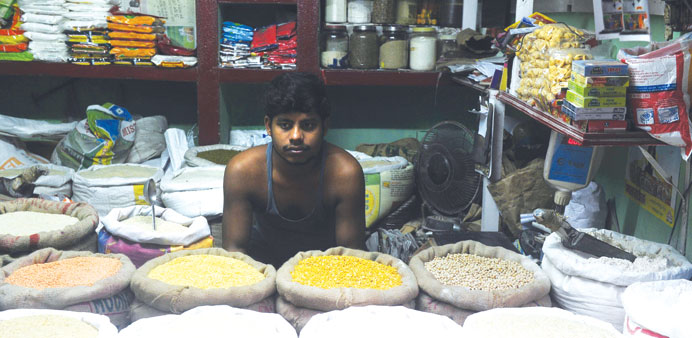
A shop-keeper waits for customers in front of rice sacks at his roadside shop in Kolkata yesterday. The Lok Sabha yesterday approved the Food Security