


European stock markets mostly fell yesterday, as a lack of fresh data once again steered investors’ eyes to when the Fed might begin tapering US stimulus, dealers said.
With trading in London closed for a bank holiday, trading was particularly light with only a downbeat durable goods report from the US moving sentiment.
“The market is at a level that will be hard to beat without some good news,” said Olivier Noel of Turgot Asset Management in Paris.
Frankfurt’s DAX 30 added 0.22% to 8,435.15 points, while the CAC 40 in Paris dipped 0.06% to 4,067.13 points.
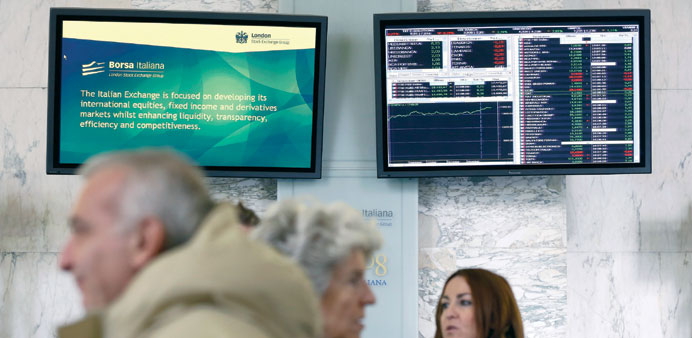
Madrid slid 0.42% to 8,649 points while, the main index on the stock exchange in Milan dived 2.10% to 16,977.76 points.
The tumble came after US economist Nouriel Roubini warned that instability in Italy over the future of Silvio Berlusconi could trigger early elections next year and weigh on the country’s standing on financial markets from this week.
Prime Minister Enrico Letta’s government needs to decide by Saturday how to reform a hugely unpopular property tax that Berlusconi’s People of Freedom party wants scrapped altogether. Berlusconi supporters have said they could bring down the government if they do not get their way.
“Our most probable scenario is elections in early 2014 but we do not exclude even sooner than that. The markets are reasoning in a similar way,” Roubini said in an interview with La Repubblica daily.
The difference, or spread, between the rates on Italian and German 10-year bonds widened to 241 basis points (2.41 percentage points) - a sign of increased concern.
Last week, emerging market currencies and sovereign debt came under renewed pressure as traders bet on an end to the Fed’s $85bn a month monetary easing.
In foreign exchange activity yesterday, the euro dipped to $1.3368 from $1.3381 late on Friday, while the dollar dropped to ¥98.66 from ¥98.71 before the weekend.
Sterling strengthened against the euro, with one pound buying €1.1642 from €1.1631 on Friday, but slid against the dollar, to $1.5574 from $1.5584.
The Russian ruble was broadly steady—but was still low—against the US currency after last week’s tumble, with one dollar costing 33.0148 rubles from 32.9918 rubles on Friday.
The Russian government yesterday cut its forecast for growth this year to 1.8% from an estimate of 2.4%.
The turbulence affecting emerging currencies prompted South Africa’s Finance Minister Pravin Gordhan to call for greater international action to get to grips with the turbulence.
Mark Williams, chief Asia economist at Capital Economics, said however that the strains “pose a much smaller risk to emerging markets now than in the past”.
He pointed to a lower foreign currency debt burdens, but warned that “cross border capital flows to many parts of the emerging world are larger now than in the 1990s”.
He said: “It is important to stress that we continue to believe that the current bout of currency volatility will prove short-lived and that a prolonged reversal of capital flows is unlikely.”
US stocks climbed yesterday with traders shrugging off a disappointing durable goods report.
The markets turned solidly higher after opening near the flat line. In midday trade, the Dow Jones Industrial Average was up 0.17%, the broad-market Standard & Poor’s 500 index advanced 0.27% and the tech-rich Nasdaq Composite gained 0.58%.