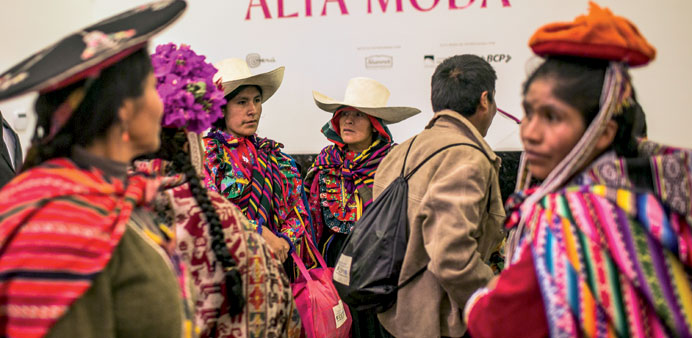
A group of indigenous Peruvian women in their finery visit the High Fashion photography exhibition in Lima.
By Luz Peralta Sanchez
His photographs of British royalty have earned him international renown and he’s snapped all sorts of jet setters in Europe, but for photographer Mario Testino, the project closest to his heart was in his native Peru.
He has assembled a series of photographs of native indigenous women wearing their traditional Peruvian costumes. In an exhibition entitled ‘High Fashion’, he is showing 27 of the finest photographs. Testino took them in the mountain city of Cusco — nearly 3,400m above sea-level and one of the highest cities in Peru — over a four-year period from 2007 to 2011.
It his most ambitious and intimate project, he says. The show has been on display since April at the Mario Testino Association in Lima. “Creating this work has been a very special personal project, not only because I explore my country’s heritage and the impact it is having on a world level, but furthermore, with this exhibition I have the opportunity to show to Peru and to the world the beauty, historic richness and importance of Peruvian traditions,” said Testino.
Housed in an old mansion from the early years of the founding of the Peruvian republic, the Mario Testino Association (MATE) museum has celebrated its first year with the show. The restored home, which dates back to 1898, has elegant porches and large rooms with high ceilings.
Testino created the association to help preserve Peru’s history and cultural diversity. “This (museum) was born with the aim of supporting the internationalisation of Peruvian art and culture and furthermore with the aim of turning this house into the only space in the world where visitors and Lima residents can always appreciate Mario’s work,” Martha Zegarra, director of the Mario Testino Association, said.
Originally from Lima, Testino, now 59, lives in London. He is considered one of the world’s finest photographers. In his ‘High Fashion’ show Testino also pays tribute to a fellow Peruvian photographer, the late Martin Chambi, who came from Cusco and who is greatly admired in Peru. Testino chose as a backdrop for his photos a copy of one that Chambi used in his own studio.
Testino said he chose the name ‘High Fashion’ in reference to Cusco’s altitude, but also, because, for him, as the name implies, ‘High Fashion’ or ‘Haute Couture’ in French — the designing and making of fashionable clothing — is “a process that requires the finest fabrics and the overflowing creativity of its makers.”
Testino contends that traditional Peruvian costumes are made with the same devotion: “hand-sewn, exquisitely embroidered, designed and woven, and rich in imagination, just as in haute couture.”
The dresses, with geometric figures that reflect the Andes and are embroidered with flowers, “are made with the ‘maquinasca’ (a modern loom) without having any pattern whatsoever to follow. Everything emerges from the ability of the weavers,” said Zegarra.
The Mario Testino museum has seven rooms. In the photographs, Peruvian women with quepis (shawls used to carry infants), bayetas (simple, plain woven cloths) and caquinas (ribbons that highlight faces) are in focus.
The dresses have their roots in pre-Hispanic times, but have slowly over time incorporated modern elements that speak of the syncretism characteristic of Peru’s indigenous cultures. Dozens of visitors visit the museum daily and admire the life-sized photographs. Also on show are five dresses with Peruvian designs that were part of the Christian Dior 2005 fall-winter collection.
The Mario Testino High Fashion exhibition has been incorporated into the Art Project, which digitalises collections from different museums throughout the world. The show will run in Lima through September 16 and then travel to New York and Europe. – DPA