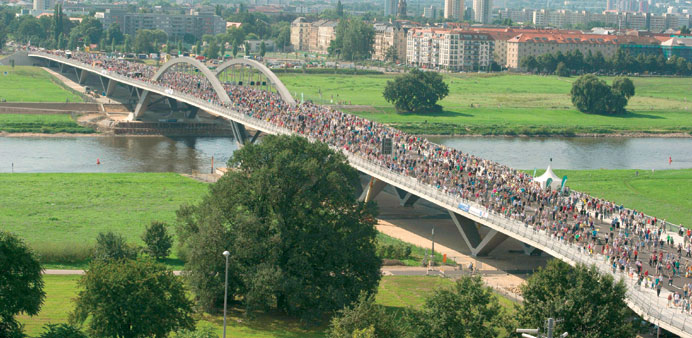
Visitors crowd on the Waldschloesschen bridge spanning over the river Elbe during its inauguration in Dresden, eastern Germany. The construction of the bridge, which is meant to alleviate local rush-hour traffic, has provoked Unesco to revoke Dresden’s Elbe valley status as a World Heritage Site. The bridge opens for traffic today.
AFP/Berlin
A bridge that torpedoed Dresden’s World Heritage status because Unesco deemed it a blot on the city’s baroque landscape will open to traffic today.
The Waldschloesschenbruecke, which at 635m (2,083 feet) becomes the longest span over the River Elbe, was built in order to alleviate traffic in the eastern German city’s historic centre.
But added to its 180mn-euro ($240mn) price tag was the blow to the city’s prestige when Unesco decided to drop the Dresden Elbe Valley from the World Heritage list in 2009 when the project to build the four-lane, concrete-and-steel bridge got the green light.
The “cultural landscape” that was designated a World Heritage site just five years earlier extends for some 20km on either side of Dresden.
Unesco argued that the new bridge would blight the view of Dresden’s old town, home to tourist magnets such as the Semper Opera House and the Dresdner Frauenkirche, an 18th-century Lutheran church.
Both were destroyed in World War II and later rebuilt.
Thomas Loeser of the Green party lamented the “bitter loss of a one-of-a-kind landscape and the de-recognition of the Unesco World Heritage title”.
For his part Holger Zastrow, head of the Saxony region’s Free Democrats, urged the World Heritage Committee to come and see for itself “that the Elbe Valley is not disturbed and more than ever not destroyed”.
The project also raised concerns over its environmental impact, notably on an endangered species of bat that lives in the area, leading to a vote on the issue by Dresden residents as well as court action.
The bat’s supporters won a small victory – a 2007 court decision stipulating a 30kph speed limit on the bridge at certain times.
The Saxony capital sustained a massive bombing raid by Allied forces beginning on February 13, 1945, sparking a firestorm that destroyed much of the historical centre of the city, much of which has been restored.
The Dresden Elbe Valley was only the second World Heritage site to be struck from the prestigious list, after Oman’s Arabian Oryx Sanctuary was dropped in 2007 after a sharp decline in the oryx population as a result of poaching and loss of habitat.