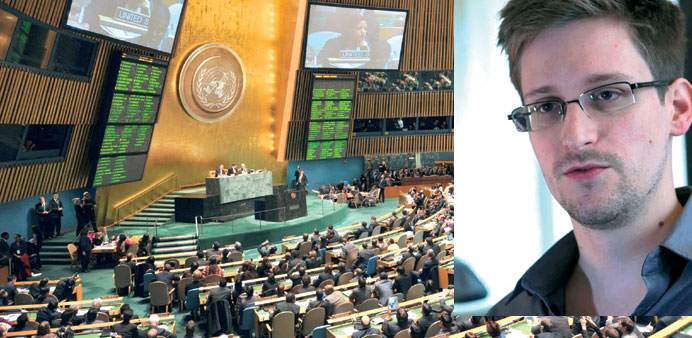
BIG SISTER: Susan Rice, the United States Ambassador to the United Nations, is seen on the television screens during the United Nations General Assembly vote on a resolution to upgrade the status of the Palestinian Authority to a non-member observer state on November 29, 2012 at UN headquarters in New York. The US’s National Security Agency (NSA) broke the encryption securing the United Nations’ internal video conferencing at its headquarters, German news weekly Der Spiegel reported yesterday, citing secret NSA documents. RIGHT: Snowden: opened the floodgate.
Reuters/Berlin
The US National Security Agency (NSA) has bugged the UN’s New York headquarters, Germany’s Der Spiegel weekly said yesterday in a report on US spying that could further strain relations between Washington and its allies.
Citing secret US documents obtained by fugitive former intelligence contractor Edward Snowden, Der Spiegel said the files showed how the US systematically spied on other states and institutions.
Der Spiegel said the European Union and the UN’s Vienna-based nuclear watchdog, the International Atomic Energy Agency (IAEA), were among those targeted by US intelligence agents.
In the summer of 2012, NSA experts succeeded in getting into the UN video conferencing system and cracking its coding system, according one of the documents cited by Der Spiegel.
“The data traffic gives us internal video teleconferences of the UN (yay!),” Der Spiegel quoted one document as saying, adding that within three weeks the number of decoded communications rose to 458 from 12.
Internal files also show the NSA spied on the EU legation in New York after it moved to new rooms in autumn 2012.
Among the documents that were copied by Snowden from NSA computers are plans of the EU mission, its IT infrastructure and servers.
According to the documents, the NSA runs a bugging programme in more than 80 embassies and consulates worldwide called “Special Collection Service”.
“The surveillance is intensive and well-organised and has little or nothing to do with warding off terrorists,” wrote Der Spiegel.
Snowden’s leaks have embarrassed the US by exposing the global extent of its surveillance programmes. Washington has said its spies operate within the law and that the leaks have damaged national security.
A week ago Britain, a staunch US ally in the intelligence field, detained the partner of a Brazil-based journalist working for London’s Guardian newspaper who has led coverage of Snowden’s leaks.
British police said documents seized from David Miranda were “highly sensitive” and could put lives at risk if disclosed.
The Guardian last week destroyed computer equipment containing Snowden files after it was threatened with possible legal action by senior British government advisers.
In an open letter to British Prime Minister David Cameron published yesterday, editors of leading Nordic newspapers said Miranda’s detention and moves against the Guardian were “undermining the position of the free press throughout the world”.
“(We are) deeply concerned that a stout defender of democracy and free debate such as the United Kingdom uses anti-terror legislation in order to legalise what amounts to harassment of both the paper and individuals associated with it,” said the letter from Sweden’s Dagens Nyheter, Finland’s Helsingin Sanomat, Denmark’s Politiken and Norway’s Aftenposten.
Earlier this month, US President Barack Obama announced plans to limit US government surveillance programmes, saying that the US could and should be more transparent.
The issue has also become a hot topic in Germany before an election next month. Some reports have suggested that German intelligence agents have cooperated with US spies.
There could be a voter backlash if it emerges that Chancellor Angela Merkel, tipped to win a third term, knew more about such co-operation than she has so far acknowledged.