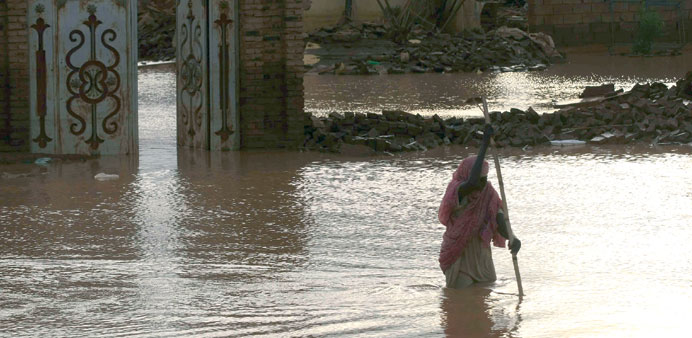
A woman whose house was destroyed in the deluge earlier this month wades through the floodwaters in Khartoum.
By Steff Gaulter
Parts of Sudan have been badly flooded this month. The waters were so deep that two weeks after the worst of the rains, parts of the capital, Khartoum, were still underwater.
The recent flooding is very unusual. In recent years there has been flooding in the east of Sudan, but it is rare in the capital and the north of the country. This is a region of the world which is a desert.
The water sources in this part of the world are the rivers, rather than the rainfall. The White Nile and the Blue Nile converge at Khartoum, forming the River Nile. This huge river then cuts through the desert landscape. In many places the arid desert reaches right up to its banks, in others, a narrow fertile strip separates the river from the desert.
The rain in the northern half of Sudan is scanty and unreliable. What little rainfall there is, normally falls between May and October. It’s heaviest in the south of the country and decreases dramatically the further north you travel. The rains come from huge towering thunderstorms which follow the sun.
As you probably know, the sun doesn’t hover across the equator for the entire year. It travels northwards in the northern hemisphere’s summer and retreats southwards again for the winter. As it moves north and south, the areas which is most intensely heated also shifts.
When the sun is directly overhead, the ground warms quickly and also heats the air above it. This causes the air to rise and form showers. If you look at a satellite picture of the earth, there is a line of thunderstorms that extends all the way round the world.
There are a few breaks in it, and a few regions where the showers are more intense, but you can trace it around the world. It’s called the ITCZ (as the inter-tropical convergence zone is a bit of a mouthful!) and it follows the sun north for the northern hemisphere’s summer, and southwards again for the winter.
The northern edge of the showers isn’t an abrupt line, the showers simply become fewer and further apart. It also varies from year to year; sometimes it’s further north than others. South Sudan, which became independent in July 2011, has ample rain.
Juba, the capital, receives a generous 954mm (38 inches) per year. This is more than London, which receives 558mm (22 inches), and Melbourne, which sees 602mm (24 inches). However, the rain gradually declines towards the north. Khartoum is approximately 700km (450 miles) to the north of Juba, and the average rainfall is just 121mm (5 inches) per year. To be officially classed as a desert, a location must receive less than 250mm (10 inches) of rain in a year. Clearly Khartoum is well within these limits.
By far the wettest month in Khartoum is August. In this month, 40% of the annual rain falls. That sounds impressive, until you realise that this is still only 48mm (just under two inches). It is clear that this is a part of the world that is not designed to deal with torrential downpours.
The downpours at the beginning of August caused widespread and deep flooding, which was exacerbated by the situation in Sudan. Civil wars have raged since independence from Britain in 1956, and not only in the south as it fought for independence. In 2003, the Darfur conflict began. The Sudan Liberation Army and the Justice and Equality Movement in the west of the country began an uprising, accusing the government of oppression of black Africans in favour of Arabs. Hundreds of thousands died in this conflict and millions were displaced. In 2011, after South Sudan gained independence, insurgencies flared in the southeastern states of Blue Nile and South Kordofan.
These ongoing conflicts have drained resources in a country which was already extremely poor country. The independence of South Sudan has also seriously hindered the economic situation; South Sudan produced three-quarters of the country’s oil, and also has the most fertile land.
Following South Sudan’s independence, Sudan is fighting to gain economic stability. The struggling nation has poor infrastructure and rustic housing. The majority of families live in one roomed houses which are held together with mud. Excessive rains not only find it easy to seep into these homes, but they also weaken the structure making them more prone to collapse.
Tens of thousands of homes are believed to have been destroyed in the recent floods, and 60 people are known to have died. Many of the deaths were caused by houses collapsing in on the residents.
This year’s flooding is said to be the worst since the devastating floods of 1988. The flooding 25 years ago was from one single storm system. The rain started at 6pm local time, and only let up at 7am the next morning. As much as 200.5mm (8 inches) of rain was reported in Khartoum, by far the wettest 24 hour period on record. The flooding left 1.5mn people homeless and Khartoum was described as resembling a ‘tropical lake’. The downpours also caused the rivers to burst their banks, ensuring the flooding persisted for a longer time period.
Torrential rainfall in Khartoum is clearly rare, but is certainly a periodic feature of the climate. Without money or determination from the government, there is little hope that things will improve before the next flood. We can only hope that the next flood will be many years in the future.