


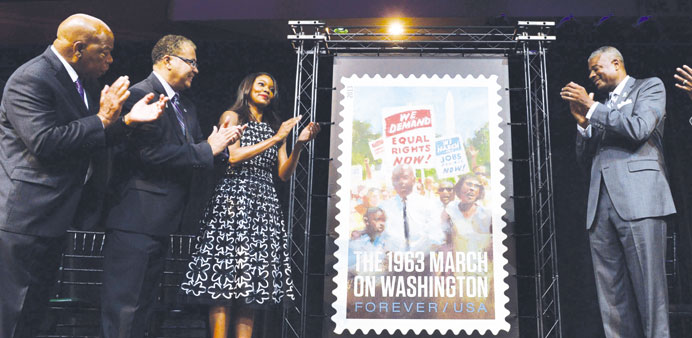
The US Postal Service unveils a limited-edition stamp commemorating the 1963 March on Washington for civil rights at the Newseum in Washington DC yesterday.
AFP/Washington
The US reflects on one of the turning points of its recent history starting this weekend when it marks the 50th anniversary of Martin Luther King’s March on Washington.
Some 150,000 are expected today on the National Mall to re-enact the moving civil rights rally where King delivered his iconic “I Have a Dream” speech from the Lincoln Memorial.
Then on Wednesday, the anniversary, church bells will peal across America while President Barack Obama, the first African American in the White House, will speak from the same steps.
Many other events are planned around the country, giving Americans a chance to reflect on how far they have come in terms of race relations - and how far they still have to go.
“I have always stated that we have made great progress in this country, but to blindly believe that our work is over is foolish and naive at best,” said civil rights activist Reverend Al Sharpton, a co-organiser of today’s event.
“If this year has shown us anything, it’s that the work of the 1963 march is not yet finished,” added Benjamin Jealous, head of the National Association for the Advancement of Colored People (NAACP), one of America’s oldest civil rights organisations.
“Voting rights are under attack, black unemployment continues to soar and thousands of black children are living in impoverished neighborhoods and attending segregated schools ... black youth are being gunned down each and every day in senseless acts of violence.”
An estimated 250,000 people of all races descended on the Mall on a sweltering August 28, 1963 day, chanting “Equality now!” and singing “We Shall Overcome,” in what was officially billed as the March on Washington for Jobs and Freedom.
Millions more watched on television - among them President John F. Kennedy, who until then had been dragging his feet on legislation to end racial segregation in conservative Southern states.
King, 34, was the last speaker of the day.
Departing from his prepared text, he famously declared: “I have a dream that one day this nation will rise up and live out the true meaning of its creed: ‘We hold these truths to be self-evident: that all men are created equal’.”
Within three months, Kennedy would be assassinated, and King himself cut down by a sniper in Memphis, Tennessee in April 1968.
But the march helped set the stage for the Civil Rights Act of 1964 that outlawed major forms of racial discrimination, followed a year later by the Voting Rights Act designed to guarantee the franchise for all black US citizens.