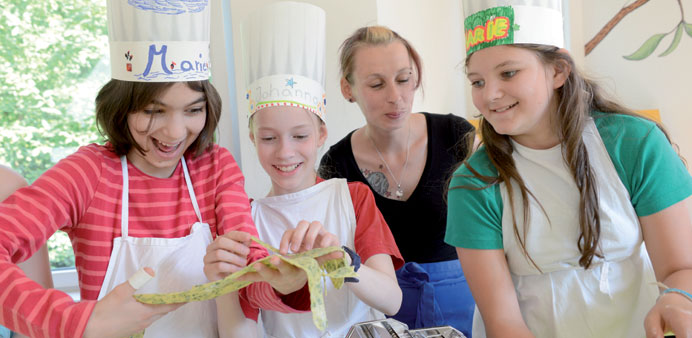
Marie, Johanna and Marie (left to right, foreground) and Children’s Restaurant staffer Beatrice prepare hand-made noodles using dough and a cutter in the Children’s Restaurant in Leipzig, during Johanna’s 12th birthday party.
By Birgit Zimmermann
Johanna is celebrating her 12th birthday standing at a kitchen worktop with her friends. Wearing white chef’s caps, the girls are kneading the dough for traditional noodles and stirring the sauce to go over them. “I think it’s fantastic, cooking together and then washing up together afterwards as well,” Johanna says.
The Leipzig Children’s Restaurant has gained a new string of converts. Karin Fahnert, a 52-year-old social educationist who set up the restaurant last year as a response to the decline in home cooking and families enjoying meals together, observes the enthusiasm with a pleased smile.
She sees her carefully designed and well-equipped kitchen with its colourful crockery as an educational institution aimed at bringing families back to the hearth.
“Nutrition is a major issue in my view,” Fahnert says, noting how eating together has declined sharply in many families, whether for reason of time, lack of interest or difficult family circumstances.
“I know of families with three children without a dining table,” Fahnert says. “Then I say to myself that a family like that cannot function properly.”
Fahnert aims to counter this trend by reaching out to as many families as possible with her Children’s Restaurant, which enthuses children for the fun of cooking at home.
Available events include children’s birthday parties and invitations to locals to try eating out on a specific culinary theme. Each participant pays 5 euros ($6) towards costs, used largely to cover the purchase of the food. The Children’s Restaurant continues to function on the basis of support from a local non-profit association.
Celebrity chefs have for some time been attacking the decline in cooking at home and the quality of food being dished up to children.
In Britain, star chef Jamie Oliver has used his reputation to take on the politicians over unhealthy and tedious food served up in schools, while in Germany, television cook Sarah Wiener has played a similar role.
Fahnert’s aims with her Children’s Restaurant are more modest. Her target is people living in the immediate vicinity. The restaurant is in the low-income eastern part of Leipzig, a city in the former East Germany. “We see an increasing number of cooking programmes on television. While the parents may watch them, they do not cook themselves, and it’s getting worse,” she says.
Word has got around on the Children’s Restaurant, where the guests go out into the garden to pick the herbs and have to do everything from the chopping and peeling to the washing up afterwards.
Children’s parties have to be booked well in advance, and there has been a string of enquiries from creches and schools in the region, including some from neighbouring states, Fahnert says.
As Johanna juggles the spoons in the kitchen for her own party, her 41-year-old mother is sitting waiting for the results. “It’s a great idea teaching children about cooking this way,” she says.
“At home we don’t eat frozen ready meals,” she insists. “But then again, we also don’t make our own noodles, starting with the dough, like this.” – DPA