


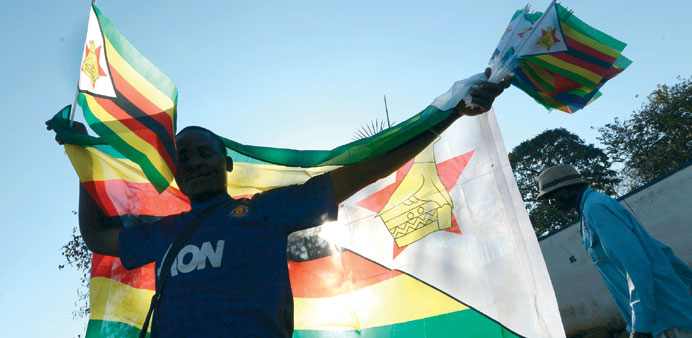
A vendor sells flags in a street in Harare yesterday on the eve of Zimbabwean President Robert Mugabe’s inauguration ceremony today.
AFP/Harare
Zimbabwe’s veteran leader Robert Mugabe will host a massive stadium-filling presidential inauguration to usher in a new five-year term today, despite expected limited attendance by foreign leaders and a boycott by his election rival.
Prime Minister Morgan Tsvangirai insists last month’s vote that returned the 89-year-old to power was rigged.
Tsvangirai will shun the ceremonies to be held at the country’s largest 60,000-seater sports stadium, where around 40 leaders have been invited.
“Expecting Tsvangirai to attend the inauguration is like expecting a victim of robbery to attend a party hosted by the robber,” Tsvangirai’s spokesman Luke Tamborinyoka told AFP.
A constitutional court ruling confirmed Mugabe as president and declared the July 31 elections “free, fair and credible,” leaving the Mugabe supporters ecstatic.
“We are excited about the inauguration ceremony,” Rugare Gumbo, spokesman for Mugabe’s ZANU-PF party, told AFP.
“Our win represents the defeat of neo-colonialism and tomorrow we are celebrating not only President Mugabe’s inauguration but the victory of Zimbabwe, Africa and progressive forces across the world.”
Unlike previous investitures which were low-key, the ceremony promises to be high-profile in what is seen as a show of power designed to confer legitimacy amid persistent questions around the vote which extended Mugabe’s 33-year grip on power.
The organisers said the event would be similar to Mugabe’s inauguration as prime minister in 1980 amid Zimbabwe’s independence.
But of the foreign leaders invited, only Namibia’s Hifikepunye Pohamba is so far known to have confirmed.
South Africa, which brokered a peace deal after the violence tinged 2008 vote, is sending Deputy President Kgalema Motlanthe. Botswana and Malawi will do the same.
Former leaders from Tanzania, Botswana, Mozambique, Namibia and Zambia will attend.
A music concert will include artists from South Africa, Zambia and Jamaica - whose iconic Bob Marley played at Zimbabwe’s independence event.
“This inauguration is being projected as the crowning of a victory of a struggle for the past 13 years against big Western powers,” said Eldred Masunungure, a political scientist from the University of Zimbabwe.
There however is also an “unintended meaning,” he said. “It can be read as farewell event for Mugabe. It reminds one of Jesus’s Last Supper.”
Thousands of Mugabe’s supporters are expected to troop in from across the country for the ceremony that was delayed after Tsvangirai legally challenged the poll result. The electoral commission declared Mugabe winner with 61% of the ballots, against Tsvangirai’s 34.
The elections ended a shaky power-sharing government formed by Mugabe and Tsvangirai four years ago to avoid a tip into conflict following a bloody presidential run-off election.
Local observers have judged the elections flawed and Western powers have raised serious doubts over the vote. But regional and continental groupings the Southern African Development Community and the African Union were less critical.
Tsvangirai condemned the election as “a farce” and “a massive fraud” and petitioned the court to overturn the result.
Among a series of complaints, he queried the suspiciously high number of voters who were turned away from polling stations in urban areas which are considered opposition strongholds.
He also charged that his party’s supporters in the rural area were intimidated by Mugabe party backers into feigning illiteracy and voting in the presence of police and election officers. Page 29
Mugabe ally, party founder Nkala dead
Zimbabwean politician Enos Nkala, who co-founded Robert Mugabe’s ZANU party and was defence minister during a massacre of some 20,000 ethnic Ndebele, died yesterday, a party official said.
“I can confirm that he died this morning,” Rugare Gumbo, spokesman for the party now known as ZANU-PF, told AFP, without giving more details.
The independent News Day said Nkala had died at a local private hospital where he was reportedly admitted on August 7.
He was 81-years-old. The cause of death is still unclear.
Nkala co-founded the Zimbabwe African National Union (ZANU) party in 1963 to fight against British colonial rule.
ZANU came to power after independence in 1980 and later joined the Zimbabwe African People’s Union (ZAPU) to form ZANU-PF, which remains in power.
Nkala served various posts in Mugabe governments, including as finance minister.
As defence minister he oversaw a state-ordered crackdown by North Korea-trained forces on dissidents in the Matabeleland and Midlands provinces between 1984 and 1987. Around 20,000 people, including women and children, were killed during the massacre named “Gukurahundi”, which means “the wind that sweeps away the chaff before the spring rains” in the local Shona language.
Nkala sought to exonerate himself, saying Mugabe directed the deployment of the troops.
In the late 1990s, Mugabe described the killings as “a moment of madness” but stopped short of apologising for them.
Nkala left government following a corruption scandal in which cabinet ministers and officials bought cars for resale using special privileges.
He later became a staunch critic of Mugabe’s rule, but last year patched up his relationship with the 89-year-old ruler.