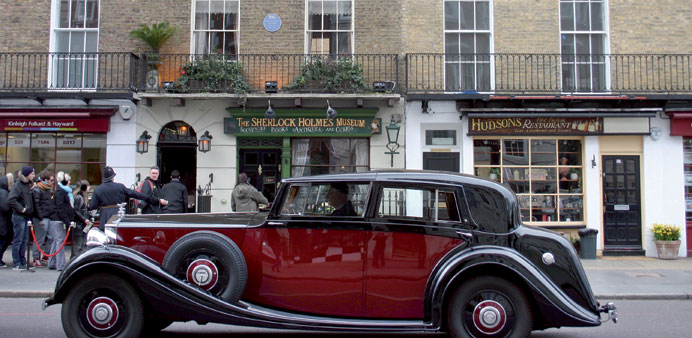
Number 221B Baker Street in London, the fictional home of fictional detective Sherlock Holmes. Parked in front is a classic Rolls-Royce car.
By Christoph Driessen
Never-ending lines of people waiting to get into the sights of London are one of the signs of a truly great city. “Mummy, they’re still standing there,” says a puzzled little London girl in school uniform as she walks past the queue outside the Sherlock Holmes Museum.
In the line, a boy is asking, “Is this where he died?” The father’s answer: “He lived here, but whether he died here, I can’t say.”
A survey in 2010 found that 60% of Britons are convinced that Sherlock Holmes — the fictional character created by Arthur Conan Doyle — really did exist. Many people even assume he is still alive today.
Every week, the Sherlock Holmes Museum receives about 70 letters addressed to the detective. A few request crime-solving advice.
TS Eliot, winner of the Nobel Prize for literature, once observed, “Perhaps the greatest of the Sherlock Holmes mysteries is this: that when we talk of him we invariably fall into the fantasy of his existence.”
The museum does not expressly deny it. But a tongue-in-cheek comment on its website says: “Visitors often ask whether Sherlock Holmes and Dr Watson really lived in the house, but unfortunately no official records of the lodgers who lived here in Victorian times exist.”
On the apartment building’s front wall there is the typical blue plaque seen attached at all the former places of residence of important persons. But on closer inspection, one notes that the usual phrase, “Here lived ...,” is avoided.
Instead the inscription reads, “221B: Sherlock Holmes — Consulting Detective 1881-1904.”
The furnishings are such that one finds it hard to hold on to lingering doubts. The apartment on the first floor looks as if Holmes has just stepped out to get a new supply of opium.
He was an acknowledged drug user, having once commented “For me, there still remains the cocaine-bottle.” There’s a fire in the fireplace and on the tables and shelves there are piles of reference books, notes and weapons.
On the second floor, things get eccentric. Without warning, the visitor finds himself looking straight at Professor Moriarty’s glass eye.
In the story The Final Problem, the “Napoleon of crime” and Holmes both plunge to their deaths in the Reichenbach Falls in Switzerland. But here Professor Moriarty comes back to life again, albeit as a wax figure.
The most surprising display item is, without a doubt, the huge stuffed head of the Hound of the Baskervilles, the dog that features in Holmes’ most famous case. This hound does not instill any fear, for its eyes look somewhat sad.
What might come next? What about Holmes’ water closet, located directly beneath the building’s roof.
Ah, so it was true that Holmes had mere human needs too! Why are we not told in the books?
Stylised and oversized is how people experience him outside the Underground station at Baker Street. The bronze statue of the crime-solving genius, complete with his pipe, deerstalker cap and cape, was erected there in 1999.
In London there are many such spots where a connection to Holmes is made. Several tours have made a specialty of Holmes, and there is the literary-historical Sherlock Holmes Walk and the Sherlock Holmes Tour focusing on locations where film scenes were shot. One guide, Richard, asks his group, “Who has read every Sherlock Holmes story?” as his tour of the West End gets under way. Six hands go up, about one-third of the group. Richard leads them straight through the theatre district.
The most atmospheric site on Richard’s tour is Godwin’s Court, an interior courtyard that was used over and over as a film setting. Everything is right to perfection — the dark brick facades, the polished black doors and the gas lamps.
Actually, in Holmes’s day, gas lamps were already fading into nostalgia, for in the 1890s, London already had electric street lighting.
The walk ends near parliament, at the Sherlock Holmes Pub, which has so many memorabilia that it seems like a museum in its own right.
Nearby is the old headquarters of Scotland Yard. At the end of a day of being immersed in Sherlock Holmes lore, it is the mundane reality of modern-day London that one starts to doubt. – DPA