


By Gautaman Bhaskaran
Once upon a time, the printed medium had political powers shivering in their overcoats. In the 1780s British Calcutta, James Augustus Hickey had the British rulers in deep trouble with the exposes he printed in his Bengal Gazette. Scandalous though they were, but true nevertheless. The paper was banned and Hickey thrown into a dark cell. That was his end.
In the 21st century, cinema has replaced print to an extent, and has become an extremely worrying feature — for politicians and the organisations they run. Iranian director Jafer Panahi, for instance, known for brilliant films such as The White Balloon and The Circle, has been under arrest — first in jail and then in his own house — since 2010.
The sentence is for six years, and he cannot make a movie for 20 years, when he will be 73! Panahi provoked the ire of the Iranian regime with his content. But the Iranian helmer was not one to stay quiet: he made a documentary within the four walls of his home, called it This is a Film, and had it smuggled to the 2011 Cannes Film Festival. Which screened and celebrated it.
There have been others who have defied Teheran, but differently. With several of his movies banned in his native Iran, Mohsen Makhmalbaf decided to leave the country in 2009. He has been living in France and England since then, and is now all set to helm his first work in English that will be produced by Film and Music Entertainment.
Titled The President, it will be shot in Georgia early in 2014, and will be his first fiction feature after his 2009 The Man Who Came With The Snow. Now, if one were to look at the plot of The President, nobody can have the least of doubt that it is political.
Set in fictional Caucasus country, The President focuses on the plight of a dictator whose government falls after a coup. Disguised as musicians, he and his son travel across the country, a travel which helps them understand the common man and his problems.
“After the Arab Spring, a number of dictators fell: Ben Ali, Mubarak, Gaddafi,” said Makhmalbaf in a recent interview. “But statistics show that there are over 40 dictators of this kind still in power.
“In the course of the Arab Spring and in the search for democracy, we have witnessed a lot of violence whether by the attack of foreign countries (as in the case of Libya where tens of thousands of people were killed and now in Egypt) or as the result of internal conflicts where 100,000 people have been killed and millions injured and have become refugees… As the result of all this violence, the road to democracy appears more and more difficult for these countries,” the auteur added.
Makhmalbaf (57) holds a French passport and currently lives in London. He left Iran after Mahmoud Ahmadinejad was elected in 2005. Some of the director’s best movies are Kandahar, Boycott, The Bicyclist, and The Gardener.
Women have also rebelled against political authoritarianism, which invariably stifles personal freedom. Golshifteh Farahani is not just beautiful, but an excellent actress, who fled Iran and now lives in Paris, often described as a city that was one of the first to talk about and practice liberty, freedom and fraternity.
Even as a schoolgirl, Farahani never hid her defiant streak. Once, she convinced her classmates to boycott school because it had no heating. Another time, she played Cupid by lying to her parents so that her sister could meet her boyfriend. (We saw something similar in Saudi helmer Haifaa al-Mansour’s Wadjda, where a little girl helps older girls pass their letters to their lovers.)
Farahani grew even more daring when she became a teenager. At 16, she shaved her head in protest against the scarf — something that no girl would do. Not just this, but she dressed like a boy and cycled around Teheran. At 17, she took up acting when her parents insisted that she learn piano.
In an interview some weeks ago, Farahani said she was far from a good girl, which Iranian society expected of her. Instead, “I chose to play with the lion’s tail,” she quipped.
At 20, she married and soon after fell afoul of Iranian authorities when she acted opposite Leonardo DiCaprio in Ridley Scott’s CIA thriller Body of Lies. She was accused of collaborating with the West. She ran away to Paris, and also divorced her husband. That was 2008.
Now, Farahani’s latest film, The Patience Stone, which went to several festivals in 2012, including Abu Dhabi, has just opened in New York. Her character in the movie is quite akin to her own real self. The film is a “statement of rebellion”.
In the movie, the woman, played by Farahani, is seen tending to her comatose husband with a bullet in his neck, and as the plot progresses, she begins to confess to her husband — partly to fight her loneliness and her boredom. The confessions stretch over several days, and with the passing of time, they get increasingly daring and scandalous. A point comes when they get so outrageous that they shake the man out of his coma. The film ends on a note of sheer drama. Farahani was wonderful as the tortured wife.
For Afghan-born director Atiq Rahimi, Farahani was not the first choice for his The Patience Stone. He thought that she was too young, too beautiful and too joyful to play the part. But Farahani was not used to taking a no. She pleaded and persisted. Eventually she threatened to learn her lines and act them out on every Parisian street. Rahimi relented and he is glad he did so. The Patience Stone has won many laurels.
And at 30, Farahani, who has been in more than 25 movies, including the critically appreciated Chicken With Plums, lives in Paris. She was seen in a short French video promoting the Cesars (France’s equivalent of the Oscars) where she exposed and said, “I will put flesh to your dreams.” Teheran was furious, and said that this was the “disgusting face of cinema”.
But the actress was not to be shackled. Recently, she posed in the nude for the fashion photographer, Paolo Roversi.
Farahani may represent the extreme end of rebellion, and men like Makhmalbaf may not be quite on the opposite side. But still, they present a picture of recalcitrance, and use the moving medium to carry their thoughts across screens and nations.
(Gautaman Bhaskaran has been watching Iranian cinema for many years, and has been fascinated by its amazing evolution from one of telling children’s stories to one focusing on politically and socially disturbing subjects. He may be e-mailed at [email protected])
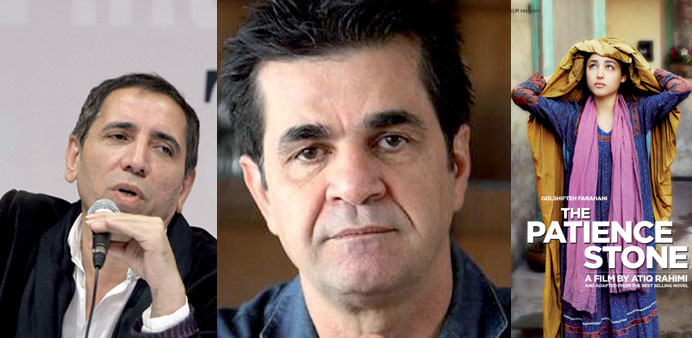
Mohsen Makhmalbaf: New frontiers ; Jafer Panahi: Defiant.