


Reuters/Cape Town
South Africa’s auto manufacturing industry came to a near standstill yesterday when about 30,000 workers downed tools, adding to the labour woes of the continent’s largest economy which has been hit by violent unrest at its mines.
The stoppage would cost the industry about 600mn rand ($60mn) a day in lost production, the National Association Automobile Manufacturers of South Africa (NAAMSA) said.
“The strike affects the entire value chain of the industry,” NAAMSA director Nico Vermeulen said.
Five of the seven companies operating in the South African auto sector, including Toyota, Ford and General Motors, said production had been halted or affected. Underpinned by government incentives, the industry contributes at least 6% to gross domestic product and accounts for 12% of exports.
A fresh round of labour unrest will be a political headache for President Jacob Zuma and the ruling African National Congress (ANC) ahead of elections next year.
The strike was called last week by the National Union of Metalworkers of South Africa (NUMSA), its largest manufacturing union, which wants pay hikes of 20% for its members, compared with inflation at 5.5%. Companies have offered 6%.
The central bank has warned about the inflationary impact of high wage settlements on consumer prices. But workers are stretched financially and often have several dependents, with the unemployment rate officially at 25%, and at 40%, according to most analysts.
Strikes also loom in the mining sector with unions seeking pay rises of up to 150%, which companies say they can ill afford as metal prices slump.
Mining strikes over the last 18 months have killed more than 60 people, slowed economic growth, hit the rand currency and led to sovereign credit downgrades.
Zuma and the ANC have faced heavy criticism for their handling of last year’s wave of wildcat strikes in the mines, which also dented growth and alarmed foreign investors.
Elias Kubeka, national motor sector co-ordinator for NUMSA, said the auto industry strike was “very well supported and all of the factories, 100%, are shut down”. Meetings between the two sides were scheduled for later.
Toyota said 80% of its 8,000-strong South African workforce had not turned up for work. Guy Kilfoil, a spokesman for BMW in South Africa, said the strike was costing it 345 cars a day.
“We work 24 hours, seven days a week. There is no production and there is no plan to make it up,” he said.
Wages in the auto sector range from about $850 a month for basic workers to $1,800 a month for qualified technicians.
In the US, according to the US Bureau of Labour Statistics, the annual average hourly wage in 2012 in vehicle manufacturing was $28.08. Assuming a 40-hour week, this would be close to $4,500 a month.
But worker productivity in South Africa is constrained by low skills and training, industry experts say.
World number one platinum producer Anglo American Platinum announced yesterday it will begin laying off an estimated 6,900 workers in South Africa on September 1.
“A month’s notice period for affected employees will commence on 1 September,” said Amplats CEO Chris Griffith, finalising plans to cut 6,000 mine and 900 corporate jobs to save around $400mn a year.
The ultimate number will depend on “voluntary severance packages, early retirement, redeployments and the filling of internal vacancies.”
The plan, initially put forward in May, comes after talks with the government and unions.
Amplats had first proposed around 14,000 job cuts. The firm, which accounts for almost 40% of global platinum sales, said it will aim for production of 2.2 to 2.4mn platinum ounces per year.
“The implementation of our proposals will help us create stability for the business,” said Griffith.
Amplats has been one of several major international mining companies that have been pummelled by labour unrest.
Many of the firm’s most productive mines are in the restive Rustenburg area, which is also home to Lonmin’s Marikana platinum mine, the scene of deadly violence a year ago.
On Friday the comrades and families of 34 miners shot dead by South African police marked the first anniversary of the bloodbath which shocked the world, and the mining sector.
Amplats profits have been obliterated by high wage bills and increased electricity costs.
At the same time, expensive deeper mines yielded lower grade metals.
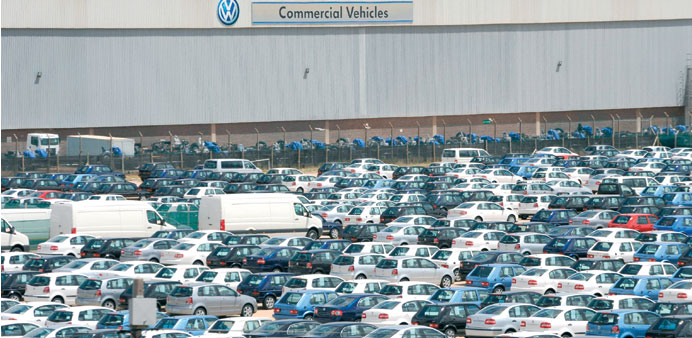
The Volkswagen plant in Port Elizabeth, South Africa.