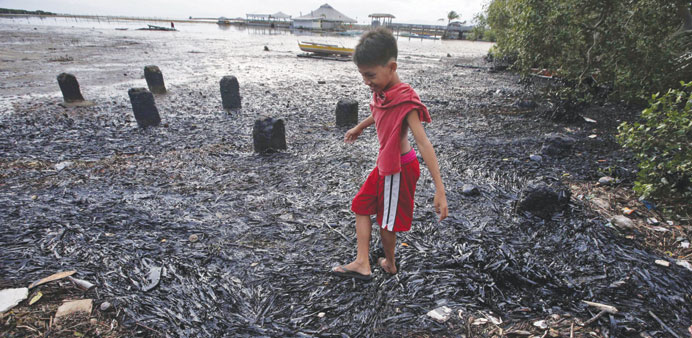
A boy walks on a bunker fuel slick believed to have come from the sunken vessel, MV St Thomas Aquinas in Cordova town, Mactan Island, yesterday.
Reuters/Talisay
As rescuers plucked more bodies from the sea after a Philippine ferry and a cargo ship collided late last week, killing at least 38 people, a vexing but familiar question faces a country plagued by an abysmal record in maritime safety: what went wrong?
Authorities say 82 people listed as missing are believed to have died, trapped in the ferry that sank to the sea floor off the central Philippine port of Cebu minutes after Friday’s collision.
Divers are trying to cut into the vessel, at a depth of 45 metres (150 feet), and plug an oil leak.
Although a formal investigation will not begin until after the rescue operation, attention is already turning to the final moments in the latest fatal shipping disaster to strike the Philippines, a country of 7,100 islands, where over-crowded or overloaded vessels are common and sea regulations are notoriously hard to enforce.
The MV St. Thomas of Aquinas, an inter-island ferry loaded with 870 passengers and crew, had been at sea for about nine hours after leaving Nasipit, a port on the southern Philippine island of Mindanao, when it approached Cebu, a bustling economic zone about 560km south of Manila.
The yellow-hulled MV Sulpicio Express Siete, laden with containers, had just left Cebu’s port with 36 crew. As they both entered a narrow channel about 600 yards wide in the dark at about 9pm, they appeared to have strayed onto the same lane from opposite sides, officials said.
Under navigational rules, both vessels must steer to the right if they are on a collision course, Commodore William Melad, head of the coast guard district in the central Visayas region, said.
The ferry repeatedly blew its horn and sent warning signals, said 2GO Group Inc, which owns the ferry.