


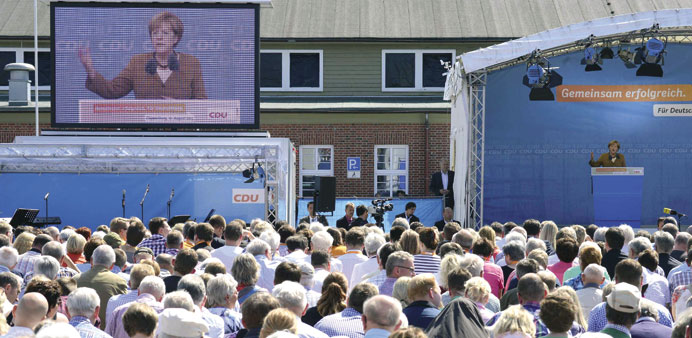
Merkel delivers her speech at an election campaign in Cloppenburg yesterday.
Chancellor Angela Merkel has warned her supporters against complacency ahead of the September 22 election, voicing fears that three leftist parties could unexpectedly join forces to oust her centre-right coalition after ballots are counted.
Even though Merkel’s conservatives hold a 16-point lead over the Social Democrats (SPD) in opinion polls, the chancellor told a rally in Cloppenburg the SPD might still break a vow and form a coalition with the ostracised far left “Linke”, or Left Party.
The SPD and Greens, who have ruled out a coalition with the Left, trail Merkel’s centre-right coalition by about eight points in polls. But the ruling coalition fears the SPD and Greens will ignore past promises and form a government with the Left, popular in the east and on 8% in voter surveys.
“Those who think the election is already in the bag and Merkel will still be chancellor no matter what might be in for a rude awakening after the polls close,” Merkel said, speaking in Lower Saxony state where her Christian Democrats lost power to the SPD and Greens in a stunning upset in January.
“Those who think this election is already won might wake up and see Germany has a government with the Left Party in it,” she added, articulating the governing coalition’s fear that the lure of power could be too strong for the SDP.
The Left traces its origins to the Communist Party in the former East Germany and has been ostracised by other mainstream parties.
“The election outcome is anything but certain,” said Merkel, who saw big opinion poll leads before the 2005 and 2009 elections melt away.
She launched her 56-stop election campaign on Wednesday.
An opinion poll published on Friday showed Merkel’s centre-right coalition was in a 46-46 dead heat against three leftist opposition parties.
If her centre-right coalition falls short, many analysts expect the conservatives and SPD to form another “grand coalition”.
But SPD chancellor candidate Peer Steinbrueck, who spoke at a rally to some 300,000 in Berlin yesterday, rules that option out for himself.
Many in the SPD oppose teaming up with Merkel as the SPD’s support crumbled after the last grand coalition.
“I’ve never seen a sight like this,” said Steinbrueck, at the rally at the Brandenburg Gate, part of celebrations this year marking the SPD’s 150th anniversary.
He drew applause during his 50-minute speech for promising to introduce a minimum wage should he take office.
“We need more ‘we together’ in this country again and not millions of sharp elbows,” he said. “I want Germany to be a country where it doesn’t matter where you come from but where the only thing that matters is where you want to go.”
Merkel warns over far-right extremism in Europe
German Chancellor Angela Merkel has called for vigilance against far-right extremism in Europe, ahead of a visit to a former Nazi concentration camp.
Merkel will travel to Dachau near the southern city of Munich on Tuesday, becoming the first German chancellor to visit the former camp.
In her weekly podcast, she said she felt “very ashamed” that police had to be deployed to prevent the desecration of Jewish institutions in Germany.
“We must never allow such ideas to have a place in our democratic Europe,” Merkel said.
“We know that we live in a democracy today. But we also know that this democracy is always under threat,” she said, pointing to the far-right extremism that persists in Europe.
The Nazis opened Dachau as a concentration camp for political prisoners in March 1933, just weeks after Adolf Hitler took power.
More than 200,000 Jews, gays, Roma, political opponents, disabled people and prisoners of war were imprisoned in Dachau during World War II.
More than 41,000 people were killed, starved or died of disease before US troops liberated the camp in April 1945.