


Agencies/Mumbai
Divers struggled in poor visibility inside a navy submarine yesterday to find 18 sailors who were inside the vessel when some of its weapons detonated and a fire swept through it as it lay berthed in a Mumbai base.
There has been no sign of life from the Russian-built INS Sindhurakshak since it sank late on Tuesday following two big explosions. It was the biggest peacetime loss for the Indian navy since a war with Pakistan in 1971 and turned the spotlight on its ageing submarine fleet.
The defence ministry said a large amount of seawater had entered the diesel-powered submarine, hampering visibility, while the damage caused by the explosion was blocking access to some areas.
“Trapped personnel have not yet been sighted or recovered,” the ministry said in a statement.
The 16-year-old submarine, which had suffered an accident in 2010, had recently returned from Russia after a 2-1/2 year upgrade of its electronic warfare and integrated weapons control systems.
The explosions took place in the vessel’s forward section, where its torpedoes and missiles are stored.
While divers managed to pry open one of the hatches, the heat of the explosion had melted parts of the internal hull twisting the others, blocking access to different compartments, the ministry said.
“Efforts continue round-the-clock to ascertain the status of the 18 trapped personnel,” navy spokesman Narendrakumar Vispute told reporters in Mumbai.
But hopes were dim for their survival.
None of the missing sailors had been sighted yet, the spokesman said. Three sailors, who were on the outside of the sub managed to leap to safety when the vessel exploded, igniting munitions aboard.
“Diving efforts are hampered by poor visibility inside the submarine, which is filled with water, extremely restricted spaces and displacement of most equipment from their original location,” he added.
Separately, a top defence ministry official who asked not to be identified said the vessel had suffered “very, very extensive damage.”
Prime Minister Manmohan Singh, addressing the nation in the traditional Independence Day speech at the Red Fort monument in Delhi, voiced sorrow at the blast, which marked a major setback for the rapidly modernising navy.
“We have deep regret that we lost the submarine INS Sindhurakshak in an accident. Eighteen brave sailors are feared to have been martyred,” he said.
“The accident is all the more painful because the navy had recently achieved two major successes in the form of its first nuclear submarine, INS Arihant, and the aircraft carrier, INS Vikrant,” Singh said.
In recent days India launched its first domestically produced aircraft carrier and began sea trials for the first Indian-made nuclear submarine, trumpeted as a “giant stride” for the country.
Newspapers lamented the loss of the submarine on their front pages. “Navy Catastrophe,” said the Indian Express in a headline. “Defender of the seas meets fiery end,” said The Hindustan Times.
The Times of India called it the country’s “worst peacetime disaster.”
INS Sindhurakshak is a Kilo class vessel which were built in Soviet and later Russian shipyards for the Indian navy from 1985 to 2000. The navy has 10 of the submarines and four German HDW boats.
Uday Bhaskar, a fellow at the national Maritime Foundation said the navy’s fleet of conventional submarines was getting smaller by the day. India has not been able to buy new submarines nor build new ones, he said.
“So we’ve been trying to make do with very old platforms,” he said.
This week, though, the navy launched its first indigenously built aircraft carrier and activated the reactor on its first domestically built nuclear-propelled submarine. But both the carrier and the submarine have been decades in the making and will take several years before they are fully operational.
Some experts argue that instead of building expensive aircraft carriers and trying to project power far beyond its shores, the navy should be focusing on its severely depleted underwater arm to counter the growing reach of the Chinese navy.
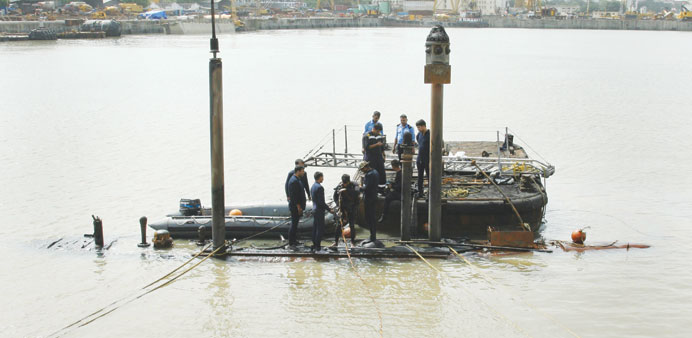
Navy divers standing on the INS Sindhurakshak submarine prepare to dive into the waters of the Arabian Sea during a rescue operation in Mumbai.