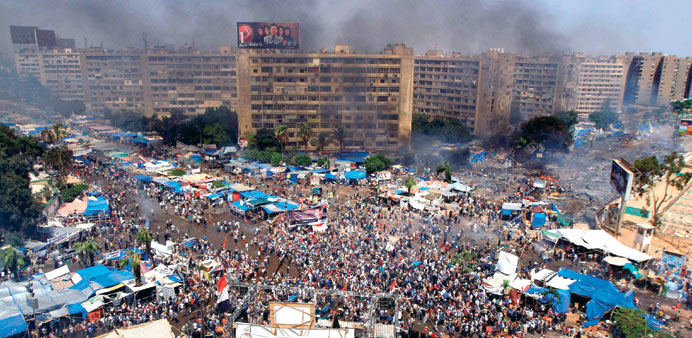
Smoke rising from the Rabaa al-Adawiya square during the clearing of one of the two sit-ins of ousted president Mursi supporters by Egyptian security forces yesterday.
Reuters/Cairo
Egyptian security forces yesterday crushed protest camps of thousands of supporters of deposed president Mohamed Mursi, shooting dead scores of people in the bloodiest day in decades in the Arab world’s most populous country.
The health ministry said 235 people were killed, both in Cairo and in clashes that broke out elsewhere in the country. Mursi’s Muslim Brotherhood said the death toll was far higher in what it described as a “massacre”.
Interior Minister Mohamed Ibrahim said 43 members of the police force were also killed in clashes with protesters.
While dead bodies wrapped in carpets were carried to a makeshift morgue near the Rabaa al-Adawiya mosque, the army-backed rulers declared a one-month state of emergency, restoring to the military the unfettered power it wielded for decades before a pro-democracy uprising in 2011.
Thousands of Mursi’s supporters had been camped at two major sites in Cairo since before he was toppled on July 3, and had vowed not leave the streets until he was returned to power.
With the assault, the authorities ended the six-week stand-off with a show of state force that defied international pleas for restraint.
Violence spread beyond Cairo, with Mursi supporters and security forces clashing in the cities of Alexandria, Minya, Assiut, Fayoum and Suez and in Buhayra and Beni Suef provinces.
The bloodshed also effectively ends the open political role of the Brotherhood, with the harshest ever crackdown on a movement that survived underground for 85 years to emerge after the 2011 uprising and win every election held since.
Security officials said senior Brotherhood figures Mohamed El-Beltagi and Essam El-Erian were arrested, joining Mursi himself and other Brotherhood leaders in jail. Beltagi’s 17-year-old daughter was among the dead.
Before he was arrested, Beltagi warned of wider conflict, and singled out the head of the armed forces who deposed Mursi on July 3 following mass protests.
“I swear by God that if you stay in your homes, Abdel Fattah al-Sisi will embroil this country so that it becomes Syria.”
In a rare sign of unease from among the Brotherhood’s opponents, Mohamed ElBaradei, a former UN diplomat, quit his post of vice president, saying the conflict could have been resolved by peaceful means.
“The beneficiaries of what happened today are those call for violence, terrorism and the most extreme groups,” he said.
But his own political movement, the National Salvation Front, showed no such qualms, declaring “Egypt has held its head high in the sky announcing victory over political groups that abuse religion”.
Since Mursi was toppled, the security forces had twice before killed scores of protesters in attempts to drive Mursi’s followers off the streets. But they had held back from a full-scale assault on the tented camp where followers and their families have lived behind makeshift barricades. Pages 8, 26