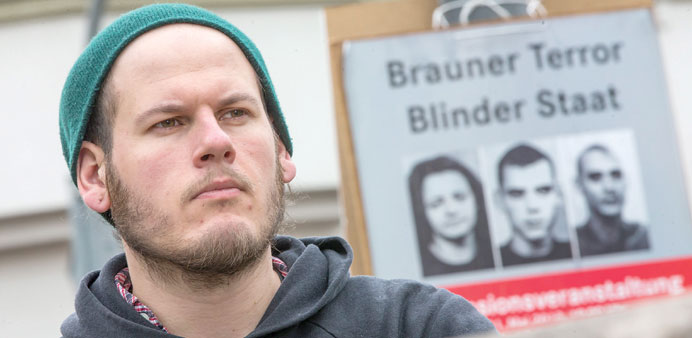
Steven Hartung with an anti-Nazi poster that shows the three suspected members of the National Socialist Underground under a text that reads, “Brown Terrorism. Blind Government,” a reference to police lack of awareness until 2011 that a neo-Nazi terrorist group existed.
By Christiane Jacke
As a teenager in a village in former East Germany, Steven Hartung was unable to resist the allure of a local neo-Nazi group, despite the best efforts of his family.
Only falling in love with an anti-fascist activist helped change his outlook. Now 25 and still bearing the tattoos of his time in the Kameradschaft, a neo-Nazi male youth club, Hartung is struggling to put all of that behind him as he studies philosophy for a university degree.
An ongoing trial of a neo-Nazi cell accused of 10 killings — the murders of eight Turks, one Greek and one woman police officer — has left him shocked. The killings coincided with his time in the extreme right. One of those on trial is a former friend.
Hartung relates how right-wing ideology pervaded life in the village in Thuringia state where he grew up. The local football club and the volunteer fire brigade were imbued with neo-Nazi attitudes. “Most of the adults were inclined to the right,” he says.
At the age of 13 he was given a CD with neo-Nazi rock music by a fellow pupil at the local school. At 15 he was invited to a meeting of the local Kameradschaft. He joined and rose through the hierarchy to become leader at 17.
In this capacity he organised talks, demonstrations and concerts, and worked to recruit new members. “At the time I was completely taken in. The neo-Nazi movement was like a new family. We all thought that only we understood the truth and that everyone else (in Germany) had been blinded to it.”
Hartung saw himself as an ideologist and propagandist, an intellectual in contrast to the movement’s notorious heavies with their shaven heads, black jeans and jackets and jackboots. He reveals the helplessness of his family. “They tried to argue with me, but at some point they gave up. They may have had no influence on me, but they did not give up on me. That was great.”
Hartung then began to probe the arguments of his leftist opponents, seeking to find ways to counter them. But instead he became insecure in his own outlook on the world. He began to find himself at odds with the members of his Kameradschaft.
At this crucial juncture a young woman he had known at school came into his life. Her political coming of age had taken her in a diametrically opposed direction and she was now active in Germany’s anti-fascist movement.
Discussion and debate led them to mutual affection, and three years ago Hartung cut his ties to his neo-Nazi comrades, going for assistance to a programme set up for precisely this purpose. It is called Exit and helps people get out of neo-Nazi gangs safely.
He left his village and registered to study philosophy in Jena, Thuringia’s second-biggest city. These days his hair is longer and covered with a woollen cap, and he wears red trainers, but his tattoos still reveal his past.
He has started having the right-wing symbols removed from his legs. “I branded myself, and now I really regret it,” he says. He is now at least able to wear shorts in the summer, and other tattoos will be removed over time.
There have been threats, issued by e-mail or SMS, and his former associates have declared him a target, although nothing has happened.
Hartung has no intention of hiding, particularly after the cell responsible for the murders came to light at the end of 2011.
He insists he knew nothing at the time of the cell — which was formed in his native Thuringia state. Some of his former comrades had talked to him about an underground right-wing “resistance,” but he had at the time dismissed this as “big talk.”
“I was shocked that something like this really existed,” he says now.
That shock is increased by the knowledge that a former close friend, Ralf Wohlleben, is now in the dock, charged with being an accessory who knew of the killings without being directly involved. “He was one of us,” Hartung says.
While he has left all that behind him, Hartung is conscious of the role he played. “I perpetrated ideological violence. I brought a few more people into the scene, and as a result I have harmed society,” he says. Cases like that of Hartung have, however, saved Exit.
The federal government had been about to cut funding to the project, but has now changed its mind.
Since 2000, Exit has assisted 500 former members of the neo-Nazi scene to leave, most of them young men between the ages of 22 and 32.
“They were all highly radicalised,” says Exit’s Fabian Wichmann, who assisted Hartung in his rethink. “We can’t force anyone to leave the scene. It has to come from the person themselves.” – DPA