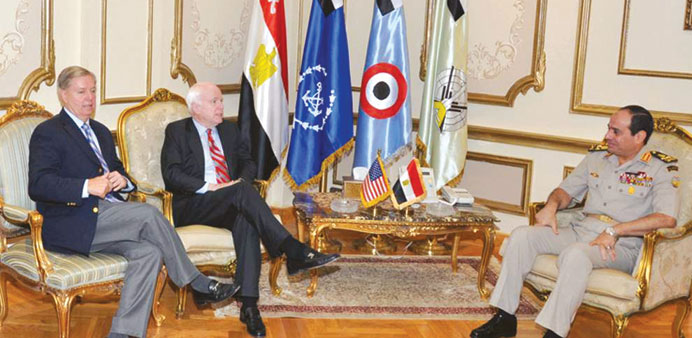
General Abdel Fattah al-Sisi meets US senators John McCain and Lindsey Graham at the defence ministry in Cairo.
Reuters/Cairo
Two senior US senators delivered a strong message yesterday to the Egyptian military, saying it should release political prisoners, start a national dialogue and return the nation swiftly to democratic rule.
Republicans Lindsey Graham and John McCain were sent to Cairo by US President Barack Obama to help resolve the crisis brought on by the army’s overthrow of elected Islamist President Mohamed Mursi.
They urged Mursi’s Muslim Brotherhood, many of whose leaders have been jailed including the deposed president himself, to avoid resorting to violence and to join a dialogue on a political way forward.
The two men’s mission reflected Washington’s anxiety at events in Egypt, a bulwark of its Middle East policy and the first Arab state to make peace with Israel.
But their comments after meeting army chief General Abdel Fattah al-Sisi, interim Vice President Mohamed ElBaradei and interim Prime Minister Hazem al-Beblawi fell well short of an endorsement of their actions.
“The people who are in charge were not elected. The people who were elected are in jail. The status quo is not acceptable,” Graham told a news conference.
They also described Mursi’s overthrow as a coup - a definition that is hotly disputed by the rival Egyptian sides and among US officials, and could trigger a cut-off off in the $1.3bn US military aid Egypt receives each year.
However, “cutting off aid would be the wrong signal at the wrong time”, McCain said.
Addressing both sides, he said: “If you think you can restore legitimacy by violence, you are wrong. Violence will only marginalise you. If you think you can only negotiate with people in jail, that’s a huge mistake.”
A spokesman for the interim government, Sherief Shawki, gave a cool response to the senators’ words.
He rejected their characterisation of Mursi’s overthrow as a coup and said the new authorities, installed by the army, had spelled out a plan for a political transition and new elections.
“There is a road map which means that what happened was not a coup and that it was Egyptian people who decided on the road map put (forward) by the military and which represents the Egyptian people. We don’t want foreign intervention to be imposed on us.”
The government would stick by that plan, he said. He also rejected the call to release jailed Brotherhood members, saying they would be dealt with by the courts.
Egypt has been dangerously divided since the overthrow of Mursi on July 3 following huge demonstrations against his rule.
He became Egypt’s first freely elected president in June 2012, 16 months after the overthrow of US-backed strongman Hosni Mubarak, who had ruled for nearly 30 years.
Mursi is now being detained at an undisclosed location and thousands of his supporters remain camped out at two protest sites in Cairo which the government has pledged to break up.
Almost 300 people have been killed in political violence since the overthrow, including 80 shot dead by security forces in a single incident on July 27.
A diplomatic push led by envoys from the US, the European Union, Qatar and the United Arab Emirates has so far helped to hold off further bloodshed between Mursi’s backers and the security forces but not achieved a breakthrough.
McCain said the senators also met members of Mursi’s Freedom and Justice Party, the political arm of the Muslim Brotherhood.
“All parties should be part of a national dialogue and reconciliation is the only way to bring out peace in this country, but also in order to take part in that national dialogue those parties should renounce violence,” he said.
The crisis has put US policy in a quandary. Mubarak was a close ally who kept Islamist militants under heel and maintained peace with Israel.
Washington was slow to support the popular uprising that ousted him and cautiously welcomed Mursi’s election.
But fears that Mursi was trying to establish an Islamist autocracy, coupled with a failure to ease economic hardships afflicting most of Egypt’s 84mn people, led to mass street demonstrations, triggering the army move.
On Monday, US Deputy Secretary of State William Burns and European Union envoy Bernardino Leon met jailed Brotherhood deputy leader Khairat al-Shater in the prison where he is being held.
They tried to persuade him to recognise that there was no realistic prospect of Mursi being reinstated and to accept a political compromise. A Brotherhood spokesman said Shater had insisted they should be talking to Mursi and the only solution was the “reversal of the coup”.