


By Peter Townson/Staff Reporter
The burgeoning arts and culture scene in Qatar has been praised by a group of artists who have been holding a number of art workshops focusing on Islamic art over the past two weeks.

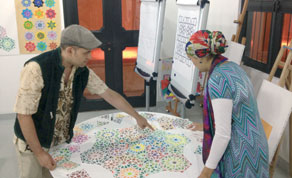
Ayesha Gamiet and Richard Henry have been leading workshops at Katara over the past two weeks
Three graduates of the Prince’s School of Traditional Arts in London, Ayesha Gamiet and Richard Henry from the UK, and Roya Mai Souag who now lives in Qatar, have been introducing families to Islamic art, geometric patterns and other techniques in a series of workshops for adults and children.
Henry is an expert in geometric design, and teaches enthusiasts about how traditional designs are put together based on shapes, while Souag’s particular interest is combining such designs with woodwork and Gamiet specialises in various aspects of Islamic art, including illumination. Gamiet is also an illustrator and is working alongside Qatar Bloomsbury Foundation Publishing and author Fran Gillespie on an upcoming project for younger readers.
The classes at Katara have been well attended and the artists explained that the tie-up with the cultural village means that they will be visiting to hold workshops three times a year.

Roya Mai Souag (centre), now based in Qatar, is impressed by the enthusiasm for arts and culture in the country
“The response has been fantastic, everyone has been really enthusiastic and they are looking forward to taking part in more classes in the future,” said Gamiet.
“We had a very diverse group of students, we got great feedback and the students produced a great standard of work,” she added.
Gamiet and Henry explained that they were excited about the opportunity to come to Qatar and teach people about traditional Islamic art: “We are very passionate about what we do and about sharing it with as many people as possible. This was a great opportunity to come to a part of the world we haven’t visited before to share this art.”
Souag, who has been visiting family in Qatar for a number of years before moving here, said that the hunger for culture and art was a major factor in her deciding to relocate. “People really want these kind of classes and they are important for the community,” she said, adding “it gives people an opportunity to produce something and see the practical side of art rather than just the theory.”
The three artists said that they had been impressed by the enthusiasm for art in the country, which has been boosted by the efforts of the Qatar Museums Authority and other individuals. With their specific interest in traditional art and culture, the Museum of Islamic Art is particularly important, and all three said that they had been highly impressed by the institution.
“The thing about the museum is the extreme quality of all of the pieces – it is fantastic,” said Gamiet, adding “some exhibitions elsewhere have some weaker pieces, but in the MIA it is noticeable that every single piece is a stunner – they are all exceptional and they are presented really well.”
Henry echoed her sentiments: “The calibre is exceptional – I particularly loved some of the 13th century doors from Cairo and the geometric patterns and design in them. The building itself is fantastic.”
The trio expressed their belief that learning about Islamic art can provide insight into how different cultures are similar in terms of creativity and design.
At first glance, geometric designs might seem to lack creativity and expression, but Henry explained that learning the basic principles behind this style of art allows an artist to be creative through their work. “It is like learning guitar – you need to know the chords and chord structures before you can play a song,” he said, adding “but when you know the, you can compose your own songs.”
Souag added: “The best analogy I have heard is that learning the principles of art is like learning a language; when you know the fundamental skills you are able to compose meaningful sentences which convey meaning.”
“It makes you realise how much different cultures have in common,” she added.
The artists said that they are pleased to provide people with the opportunity to learn more about their own culture and traditions. By engaging with the work and producing their own pieces, art enthusiasts in Qatar have had the chance to become more accustomed to their past.
“It is a way of allowing people to reconnect to their heritage,” he added.
Souag noted her excitement at the ongoing development of art and culture in Qatar, and the enthusiasm of the authorities and the people here for their culture and its significance as the country continues to grow.
“It is fantastic that everyone is proud of their Islamic heritage – to see this happening here is so wonderful,” she said.