


 |
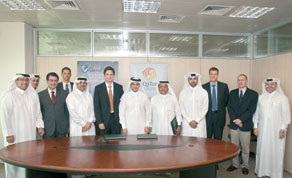
| QSTec and Gasal officials at the agreement signing ceremony |
Qatar Solar Technologies (QSTec) and Gasal have successfully completed negotiations on a hydrogen and nitrogen long term supply agreement following a signing ceremony held at QSTec’s West Bay headquarters yesterday.
Gasal Q.S.C. will invest in multiple high purity hydrogen production units and extend and connect QSTec to its industrial gas pipeline system in Ras Laffan Industrial City (RLIC) for nitrogen.
The new units will be designed and built by Air Liquide Engineering and will be commissioned and operated by Gasal through an extension of its pipeline system in RLIC during 2013.
Dr Khalid Klefeekh al-Hajri, chairman and CEO of QSTec, said: “The signing of the agreement with Gasal represents a significant milestone for QSTec and brings us closer to building a brand new industry of solar energy in Qatar. Our polysilicon plant will need pure hydrogen and nitrogen gases in order to make the very highest quality of polysilicon; the essential building block of the world’s most efficient solar technologies.”
Qatar Solar Technologies’ number one priority is providing solar solutions that are sustainable, efficient and the very best quality. QSTec will start by producing high quality, solar grade polysilicon; the key ingredient that goes into making the world’s most efficient solar technologies such as solar cells and modules that convert the power of the sun into energy. This solar energy will provide a sustainable alternative source of energy whilst conserving and protecting Qatar’s natural resources for the future.
In the not too distant future, QSTec aims to build solar modules made in Qatar, made from QSTec’s own polysilicon for local use and for export across the world to be used in a wide variety of solar technology solutions and applications.
In phase one QSTec’s $1bn polysilicon manufacturing plant will produce 8,000 metric tonnes per year (MTPY) of polysilicon and is designed to expand as demand grows.
Once this 8,000 MTPY of polysilicon is converted into modules, it will generate the equivalent of 1.4 gigawatt (GW) of solar energy. Eventually, more than 45,000 MTPY of polysilicon will be able to be produced on QSTec’s 1.2 million square metres Ras Laffan location with the plant being designed to seamlessly incorporate ingots, wafers, cells and module manufacturing facilities.
This 45,000 MTPY of polysilicon will make 6 GW of solar energy once converted along the solar value chain.
Dr al-Hajri added: “We aim to become one of the world’s leading integrated solar companies, with our products and solutions used locally in Qatar and exported across the region and globally; ensuring a sustainable industry for Qatar whilst reducing greenhouse gas emissions worldwide.”
QSTec will have several positive effects for Qatar. Firstly, in line with Qatar’s National Vision 2030, it will help diversify the economy. Secondly, it will help drive technological research and development. Finally, it has the potential to diversify the country’s energy sources and open up new business investment and export opportunities for Qatar.
Christian Last, the chief executive officer of Gasal, said: “We are very proud to be associated with QSTec and Qatar Foundation in this joint undertaking to support the renewable energy sector and sustainable environmental solutions as part of Qatar’s National Vision 2030. We would like to thank QSTec for allowing us to achieve this milestone of our development with the first hydrogen production of Gasal in Ras Laffan Industry City. It means a lot to us that QSTec, Qatar’s pioneer in polysilicon, has taken the decision to outsource its industrial gas requirements and to rely on the high level knowhow and services of Gasal.”