


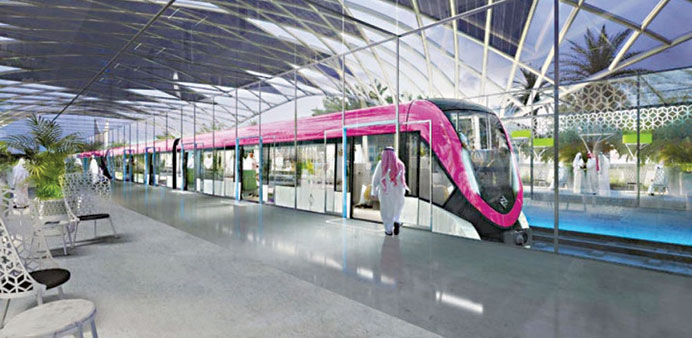
An artist’s impression of a Riyadh metro station. While the metro projects are part of an effort to improve social welfare, in the longer term, the world’s top oil exporter is trying to diversify its economy away from oil.
Riyadh metro projected to carry 1.16mn people daily at start; poorer Saudis, women may be major customers; metro projects could diversify economy in top Saudi cities; part of effort to curb rise in domestic oil consumption; assembling foreign labour force will be challenge
A $22.5bn plan to build Riyadh’s first metro rail system aims to achieve more than improving the quality of life in the congested Saudi capital: it is part of an ambitious effort to shift the country’s economy beyond oil.
The government awarded contracts for the system to three foreign-led consortia on July 28. Six rail lines carrying electric, driverless trains and extending 176km (110 miles) are to be completed by 2019.
Similar projects are underway in other top Saudi cities; last August the government approved a $16.5bn plan to modernise the transport system in Makkah, including construction of a metro, and Jeddah is preparing plans to build a metro that would cost around $9.3bn.
The projects are part of an effort to improve social welfare for millions of Saudis. Saudi Arabia aims to ensure social peace by ramping up spending on hospitals, schools and other infrastructure.
In the longer term, the world’s top oil exporter is trying to diversify its economy away from oil, to reduce its vulnerability to the next big drop in global energy prices.
The metro systems could aid that drive by changing the way Saudi cities operate, helping them develop easily accessible commercial and light industrial districts which house companies outside the oil sector, while stimulating real estate projects and other investment along the rail lines.
“I think the metro will transform Riyadh. With 170km of rail, people will always be close to the metro. It’ll not just solve the traffic problem but also connect the financial hub, airport, malls and other parts of the city,” said Miguel Jurado, head of Spanish firm FCC Construction, which will help to build the project.
Ibrahim al-Sultan, head of the government body which supervises the project, estimated that each riyal spent on it would generate an indirect economic return of 3 riyals.
Concern about the country’s extreme dependence on oil was underlined last week when Saudi billionaire Prince Alwaleed bin Talal, in an open letter to the government, called for immediate steps to diversify the economy.
The metro systems may also help Saudi Arabia manage its oil resources more efficiently; only about 2% of Riyadh’s 6mn population currently use public transport, leaving most of the rest dependent on gasoline-guzzling cars.
Growth in domestic oil consumption, as the country’s young population expands, has been outpacing rises in oil production capacity. So over the next decade or two, Saudi Arabia could be forced to cut back its oil exports; the metro systems buy it time before it faces such a crunch.
“The metro will drive down energy requirements for the transport sector, if the metro is incentivised by the government as a replacement to motor vehicles, and reduce environmental pollution,” said John Sfakianakis, chief strategist at investment firm MASIC.
The Riyadh metro is projected to carry 1.16mn passengers daily when launched, increasing to nearly 3.6mn within 10 years - a significant fraction of all trips in the country, which currently has a population of about 28mn.
Saudi Arabia now consumes about 500,000 bpd of oil in the form of gasoline, and exports under 8mn bpd.
While the metros are unlikely to persuade some Saudis to abandon their love for the automobile, others may welcome the chance to escape severe traffic congestion in the big cities.
The metros may also have a social impact by making it easier for women to move around, in a country where they are not allowed to drive. The Riyadh metro carriages will have special “family sections” giving women privacy.
“For sure I will use the metro - it will be a major solution for the women problem in our society, since we don’t drive,” said Alaa Hassan, a female university student in Riyadh. “I go to my university by minibus and I pay 2,000 riyals ($535) per month; other classmates who live nearer pay 800 to 1,000. For sure the metro will be cheaper.”
The government has not said exactly how it will fund the Riyadh metro project, although bankers have been speculating about possible issues of sukuk (Islamic bonds) which could help to deepen the country’s market in state-backed debt.
After more than two years of high oil prices, financing is not expected to be a problem; the government’s budget surplus in 2012 alone was 386.5bn riyals ($103bn).
But assembling the labour force to complete the project on time may be a challenge, because the country has been tightening controls on its large population of foreign workers in an effort to reduce unemployment among Saudi citizens.
A crackdown on illegal foreign workers caused tens of thousands of people to be deported or decide to leave the country this year. Fees designed to encourage companies to limit their use of foreigners, who are cheaper to hire than Saudis, have hurt profits at some Saudi construction firms.
“The workforce will be a challenge...We will need about 15,000 people during the whole period of work,” FCC’s Jurado said. “We have a period of eight to ten months to arrange for all these workers.”