


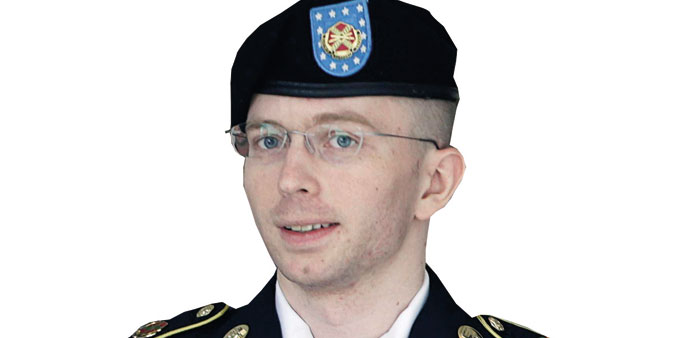
AFP/Washington
The sentencing phase began yesterday in the military trial of Bradley Manning, the US soldier convicted of espionage for leaking hundreds of thousands of secret files to WikiLeaks.
Manning was acquitted of the most serious charge of “aiding the enemy” on Tuesday but found guilty of espionage and other charges carrying as much as 136 years in prison.
The sentencing hearings, which could take up to a month, will see the defence reprise its argument that Manning - responsible for the biggest intelligence leak in US history - was a well-meaning if naive would-be whistleblower.
“People should know that the trial is far from over. There’s a maximum of 136 years but there’s no minimum in the military system,” said Nathan Fuller, the spokesman for a group formed to support Manning.
He said the defense had filed motions to merge some of the charges and to let Manning serve time for different counts simultaneously.
The prosecution, which insists Manning betrayed his uniform and his country, said it will seek the maximum sentence as well as a dishonorable discharge and a fine.
Military prosecutor Ashden Fein said he would illustrate the impact of Manning’s “criminal conduct” on US forces.
He then called to the stand retired Brigadier General Robert Carr, a counterintelligence expert, who testified about the importance of protecting “our sources and our capabilities.”
Each side is expected to present about 10 witnesses - possibly including Manning himself. The military judge who found Manning guilty, Colonel Denise Lind, will also decide his sentence.
Lind confirmed yesterday that Manning will be credited 1,274 days served to date, including 112 days for “unlawful” pre-trial solitary confinement.
Tuesday’s verdict followed an exhaustive two-month court martial at the Fort Meade military base in Maryland near the US capital.
The 25-year-old US Army private was working as an intelligence analyst near Baghdad when he was arrested more than three years ago.
After admitting to the leaks earlier this year, Manning was ultimately found guilty of all but two of the 22 counts against him.
The prosecution had argued that Manning’s actions directly benefited Osama bin Laden and Al Qaeda, but Lind found him not guilty of knowingly aiding the enemy, which would have carried a possible life sentence.
Lind did find him guilty of seven of eight counts he faced under the Espionage Act, including stealing US government property and computer fraud relating to confidential records.
He was also found guilty of “wanton publication of intelligence on the Internet.”
Manning was found guilty of leaking graphic cockpit footage of two US Apache attack helicopters killing 12 civilians on a Baghdad street in 2007 - a video dubbed “Collateral Murder” when it was released by WikiLeaks.
But he was found not guilty of leaking classified records relating to a US air strike in the Granai region of Afghanistan in May 2009.
He was convicted on all five counts related to his failure to obey military orders and regulations in his handling and storage of confidential information.