


|
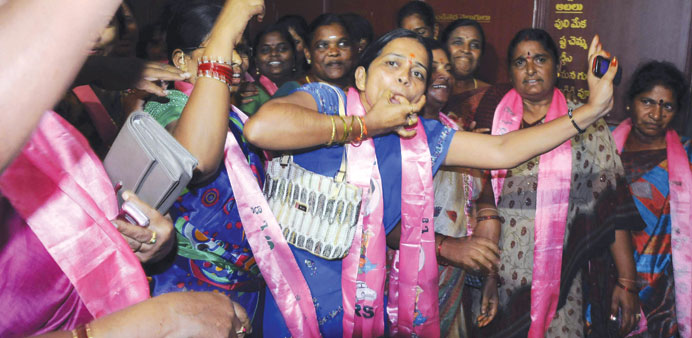
Will the Indian government’s move to split the southern state of Andhra Pradesh and create a new state of Telangana open up a Pandora’s box? |
It looks likely, because soon after the announcement on Telangana was made, several groups launched strikes and protests to give new momentum to their own long-standing demands for separate states.
The step towards creating Telangana, recognising the aspirations of majority Telugu-speaking districts of Andhra Pradesh, has reinvigorated the hopes of the leaders of other movements in India.
Take, for example, Gorkhaland and the Nepali-speaking Gorkha people living in the tea-producing Darjeeling region. Or Bodoland, for the Bodo tribal people in the state of Assam.
There are as many as a dozen statehood movements, ranging across linguistic, ethnic and economic lines in India.
Telangana has a population of 35mn, including Hyderabad, one of India’s biggest cities. So the decision has highlighted questions about how India - the world’s largest democracy - will handle issues surrounding identity and territory.
“If there is a Telangana, there has to be a Gorkhaland,” said Roshan Giri, general secretary of the Gorkha Janmukti Morcha (GJM, Gorkha Peoples’ Freedom Front) that has been fighting for a state for the Gorkhas.
The GJM has called for an indefinite strike to press its demands.
“We are planning to step up our agitation in light of the new development,” Giri said. “It will be the final battle.”
Over the past 20 years, there’s been much violence and many deaths, and the region’s economy - which is largely centred on tea production, tourism and timber - has been badly hit.
Greater autonomy has been given to the region in recent years, with the latest move the setting up of a Gorkhaland Territorial Administration - an autonomous and elected hill council that is now run by the GJM. But Giri said that was not enough.
And elsewhere, in the north-eastern state of Assam, that stand is being echoed by the All Bodo Students’ Union (ABSU). Its president Pramod Boro says the Bodo people are reviving their movement because they are not satisfied with the current Bodoland Territorial Council. The ABSU has been campaigning for a separate Bodo state.
The list of statehood movements in India is long.
In the north-eastern state of Manipur, the Kuki tribal people are campaigning for a Kukiland.
And in the Coorg region of southern Karnataka state, there’s support for a separate state for the Kodagu people.
But the creation of states on ethnic or linguistic identities, runs counter to the “Idea of India”, political analysts say.
Managing diversity in a country with a population of 1.2bn will be a massive challenge for governments for years to come.
“The announcement of Telangana is most worrying. India is a most diverse country in terms of social, racial, religious, and linguistic lines, and despite the diversity we have stuck together and functioned as a fairly efficient democracy,” said political commentator A Surya Prakash.
“In the past 20 years, the federal establishment has become really weak, with the emergence of powerful regional leaders.”
Activists campaigning for a Vidarbha state to be carved out of the western state of Maharashtra have blamed economic neglect and poor governance for an agrarian crisis that has seen 32,000 indebted farmers committing suicide in the last 10 years.
And Mayawati, the powerful opposition leader in the country’s most populous state of Uttar Pradesh, has renewed a demand to divide the state into four smaller units.
Political scientist Valerian Rodrigues backs the creation of Telangana, but says that acceding to demands such as those for Gorkhaland may be “dangerous” as they could lead to ethnic cleansing in the areas.
“There might be several regional demands, but for every case, sound political judgment and good reason should be applied,” he said.
“There is no single yardstick with which to handle such mass upsurges. The overall equilibrium in the country has to be maintained.”