


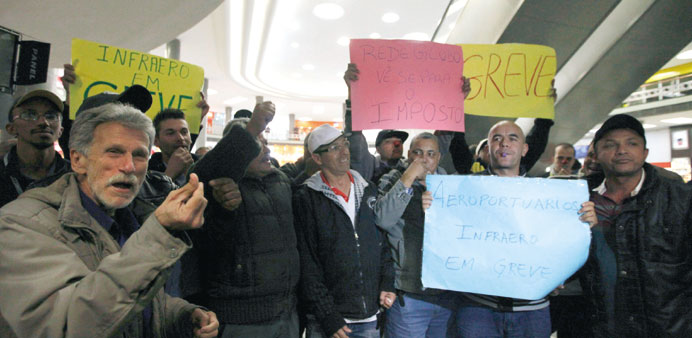
Workers of Infraero take part in a strike at Congonhas airport in Sao Paulo yesterday.
By Anthony Boadle, Reuters/Brasilia
President Dilma Rousseff moved quickly yesterday to improve bus services in Brazil’s largest city, Sao Paulo, where protests over a fare increase in June triggered an outburst of national discontent that battered her popularity.
Rousseff announced that 3bn reais ($1.31bn) in federal money will be invested in creating 99km of new express lanes to speed up bus services in Sao Paulo, the country’s financial capital.
“Brazilian cities cannot expect people to spend six hours of their life every day in a bus,” she said at an event in Sao Paulo where she also announced more funds to clean up the city’s filthy creeks and rivers.
It was a protest over a planned increase in bus fares in Sao Paulo that set off a month-long wave of massive protests against Brazil’s high cost of living, poor public services, corruption and the misuse of government money.
More than 1mn Brazilians took to the streets at the peak of the protests, rocking the country’s political establishment and undermining Rousseff’s popularity to the point where her chances of re-election next year are now unclear.
Deficient public transport, a major cause of anger for Brazilians who endure long commutes to get to work or study, has resulted from decades of neglect and lack of investment that left Brazil with such dilapidated infrastructure that it has become an obstacle to economic growth.
The funds for bus lanes were already earmarked by Rousseff’s government in its investment programme to speed up the country’s sluggish growth.
Since the protests, and with elections emerging on the horizon, Rousseff has been under pressure to boost spending, at a time when she is trying to regain credibility as a fiscally responsible leader.
Sporadic protests and rioting have continued in Sao Paulo and Rio de Janeiro to demand the ouster of the governors of those states.
Rousseff made the announcement about the investment alongside Sao Paulo’s mayor Fernando Haddad, a rising star in her ruling Workers’ Party.
She said 55% of Sao Paulo’s 11mn inhabitants rely on public transport and Sao Paulo has the smallest metro underground train system in the world for a city of its size.
Rousseff announced additional investments of 3.6bn reais to drain and clean up eight filthy creeks and recover the springs that feed two reservoirs that supply drinking water to the city. Garbage, wastewater and unauthorised squatter settlements have compromised the springs in recent years.
Rousseff’s government will spend 1.5bn reais to build low-cost housing to resettle families living on the banks of the creeks and reservoirs, she said.
Workers go on strike at state-run airports, demanding higher wages; few flights affected
Workers at several government-run Brazilian airports went on strike yesterday to press demands for higher pay and better work benefits, their union said.
The National Union of Airport employees (SINA) said the indefinite work stoppage went into effect at all 63 airports run by the federal agency Infraero.
But Infraero said only six airports were affected: Sao Paulo’s Congonhas, Rio’s Galeao and those in the cities of Vitoria, Recife, Fortaleza and Salvador, with 10.5% of flights delayed.
Privately-run airports such as Sao Paulo’s Guarulhos, the country’s busiest, were operating normally.
The strikers are seeking a 16% pay increase and better work benefits. They also oppose airport privatization.
The Infraero spokeswoman said negotiations with SINA were ongoing and the company was awaiting counter-proposals from the union, which has scheduled a meeting to discuss the issues.
The company said contingency measures were in place to ensure essential services. Infraero said its 63 airports handled 10.6mn passengers in June.
In December, Brazilian President Dilma Rousseff announced that Rio’s Galeao airport and Belo Horizonte’s Confins would be privatized during a September 2013 auction.