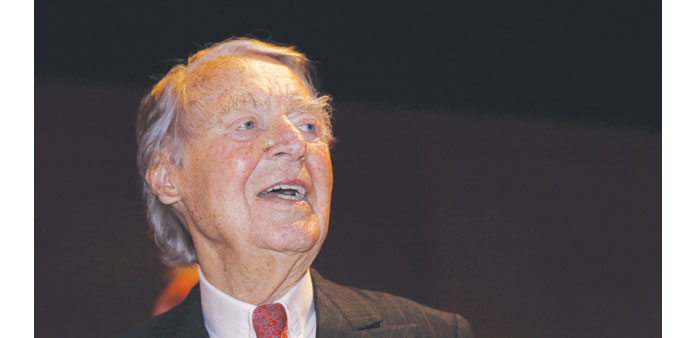
January 2012 file photo of Berthold Beitz pictured before the annual meeting in Bochum. Beitz died on Tuesday, ThyssenKrupp AG reported yesterday.
Reuters/AFP/Frankfurt
Berthold Beitz, the 99-year-old conservative head of the Krupp Foundation, died on Tuesday, potentially opening the way for deeper change at Germany’s largest steelmaker ThyssenKrupp, already in the midst of a major strategic shift.
The death of Beitz, famous in Germany for rescuing Jews from the SS during World War II, was confirmed in a statement by the foundation yesterday and prompted tributes from Chancellor Angela Merkel and Jewish leaders.
World Jewish Congress president Ronald S Lauder called him “one of the great Germans of the past century” for his actions saving hundreds at the oil refinery he ran in the Boryslav region, now part of Ukraine, between 1941 and 1944.
“For many Jews he was a beacon of hope in a sea of despair,” Lauder said. “He was a hero of the Holocaust at a time when it was a crime to be a humane person. He will never be forgotten for his tremendous acts of kindness.”
The Alfried Krupp von Bohlen und Halbach Foundation, which Beitz headed, has long been seen as a barrier to a takeover or break-up of ThyssenKrupp, which is struggling to swallow billions in losses on its US operation.
Beitz controlled board appointments and pulled strings in the background of an operation which ranges from steelmaking to elevators, submarines and industrial equipment.
For years he had blocked any dilution of the foundation’s roughly 25% stake which allows it to block capital changes.
But earlier this year, Beitz appeared to signal a change in tone.
“I will not stand in the way of any steps which are for the good of the company,” he told German paper Suddeutsche Zeitung, which many took to mean the foundation would allow a capital increase.
“Chief executive Heinrich Hiesinger has become much more autonomous recently and for example cut the dividend to safeguard Thyssen’s cash, but I expect that that management may be able to act even more freely now,” a steel analyst said.
The foundation did not immediately announce a replacement for Beitz, a powerful businessman and former insurance executive who has headed the body since 1968.
The Krupp Foundation is an unconventional shareholder. Rather than being focused on maximising profits, it is a philanthropic body tasked with funding social projects in the areas of education, science, healthcare, sports and culture.
Beitz played a key role in persuading the Krupp dynasty to hand over operational control of the company to the Krupp foundation and in 1998, helped engineer the merger between Krupp and Thyssen to form today’s ThyssenKrupp.
“Germany has lost one of its most respected and successful corporate leaders who influenced Germany in important areas,” Merkel said in a statement. “What should in particular be remembered is his courageous and exemplary efforts to protect Jewish workers during World War II and his early efforts to build bridges into Eastern Europe.”
After studying to be a banker, Berthold Beitz became a manager at an oil company in Boryslav, during World War II part of Nazi-occupied Poland.
With a relatively large Jewish population, Beitz witnessed their persecution, deportations and murder by the Nazis and still only in his 20s, decided to act, making his company a refuge.
He was able to review the Jews being rounded up for transportation to the death camps and argue that he needed those qualified for his business, backed by the help of his wife Else.
“Thus in August 1942, he extricated 250 Jewish men and women from the transport train to the Belzec extermination camp by claiming them as ‘professional workers’,” the website of Israel’s Yad Vashem Holocaust memorial said.
“We watched from morning to evening as close as you can get what was happening to the Jews in Boryslav. When you see a woman with her child in her arms being shot, and you yourself have a child, then your response is bound to be completely different,” the website quoted him as saying.
Yad Vashem later honoured the couple, designating them as “Righteous Among the Nations”.
In 1942 he was reported and questioned but, thanks to having a school friend in the Gestapo, was released.
Beitz, who would have turned 100 in September, was recruited to Krupp, part of the Nazi military machine, in 1953.