


AFP/Granges-pres-Marnand, Switzerland
Swiss investigators have pointed to signal-jumping as the likely cause of a head-on train collision in the west of the country that killed a driver and injured 26 other people.
“The investigation focuses on the likelihood that the train travelling from Payerne failed to respect a signal,” Jean-Christophe Sauterel, police spokesman for Switzerland’s Vaud region, told reporters.
The collision between two local trains occurred around 7pm (1700 GMT) on Monday, just outside the train station in Granges-pres-Mornand, a village located between the Geneva and Neuchatel lakes in the French-speaking region of Switzerland.
One train had been travelling from the town of Payerne to the lakeside city of Lausanne, 38km to the south, while the other one, a faster regional service, was travelling north from Lausanne.
The driver of the northbound train, a 24-year-old French citizen who lived in the region, was killed.
His body was pulled from the wreckage early yesterday after a frantic rescue operation.
Daniel Antonez, a resident of nearby Moudon, said he had heard the impact.
“It’s one I often take. I’m sure I know some people who were on the train,” he said.
Flanked by cornfields, the two mangled trains were still on the track yesterday, both engines locked into each other and lifted slightly off the ground as workers used beams to prepare to remove them.
Forty-six people were believed to have been travelling on the two trains. Police did not rule out the possibility of finding another victim in the wreckage.
“Two adults and a child are still in hospital out of the 23 recorded injured, but their lives are not in danger,” said Jocelyn Corniche, the emergency services’ chief physician.
The relatively slow speed of the southbound train, 40kph, appeared to be one explanation why more people had not died. The speed of the northbound train has yet to be confirmed.
Accident investigators were still trying to understand why the southbound train, operating a slower service between a string of communities, failed to wait for the passage of the faster northbound service, which does not stop at Granges-pres-Marnand.
Sauterel stressed that the issue of criminal responsibility for the crash was not under discussion for the moment.
Swiss federal railway company CFF offered its condolences to the dead driver’s family.
“The management and employees of the CFF are shocked by the death of their colleague,” the company said in a statement.
Rescuers had worked into the night under arc lamps, using special equipment to cut through the wreckage and reach the missing driver.
They retrieved his body at 1.30am (2330 GMT) yesterday but it was not clear whether the Frenchman had died on impact.
The collision came in the wake of the July 24 tragedy in Santiago de Compostela, when a speeding train flew off the rails, killing 79 people. A crash in suburban Paris a week earlier left seven dead.
“It makes your blood run cold,” Swiss resident Antonez said, referring to the string of rail accidents in Europe.
Two regional trains collided at Neuhausen-am-Rheinfall in northern Switzerland in January, resulting in 25 people suffering light injuries.
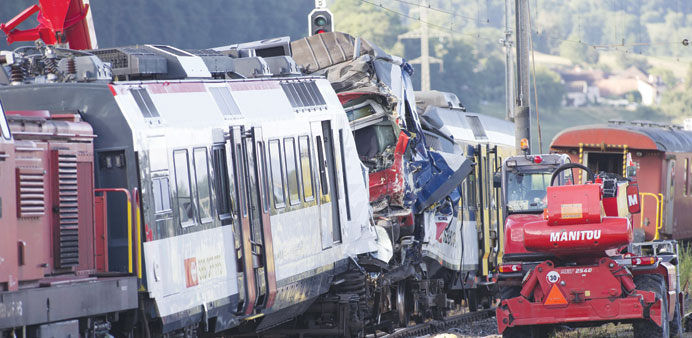
Scene of the train collision in Granges-pres-Marnand.