


By Sabrina Gorges
The doorway is almost too small even for a short person. Behind the wooden door, one’s eyes at first take in only the darkness, while cool, damp air streams out to the visitors.
You duck your head instinctively and give and take warnings with the others, and nobody stumbles or bumps into the next person. Inside the cave, the tallest visitors’ heads are nearly touching the ceiling. Everyone is turning in a circle and after the initial caution, a sense of enchantment takes over.
This cave is a home. Instead of wallpaper the walls are decorated by chisel markings. Instead of floor boards there is firm earth beneath your feet. Light is coming in through a single tiny window.
Rural workers painstakingly carved this spare dwelling out of a sandstone wall with their hands more than 160 years ago. The cave dwellings are located on the Schaeferberg mountain in Langenstein, now a part of the Harz Mountains city of Halberstadt. They belong to the city and each year attract some 12,000 visitors.
Siegfried Schwalbe, chairman of the Langenstein cave dwellings association, lovingly dubs them “cliff villas” but notes that their origins were a grim matter.
“They came about from sheer desperation and an absolute housing shortage,” Schwalbe says. “People told the homeless land labourers in the mid-19th century, carve yourselves a home from the rocks. And that’s just what they did.”
A genuine street of cave dwellings evolved on the Schaeferberg mountain. “The conditions were the very best here,” the 73-year-old Schwalbe noted. Historians learned that large families paid the equivalent of eight pennies for a “construction site.” That’s all they paid, Schwalbe said. Beyond that, “no rent, nothing.”
“They worked as much as an entire year to carve away at the sandstone rock with their own power. So they weren’t about to have to pay for it on top of it all,” he said.
The families carved out a dwelling of some 30 sq m — a living room, a kitchen and a bedroom — from the soft stone. An open fire provided warmth and was where the cooking took place.
“There were no doors inside because the heat had to circulate,” Schwalbe points out. Holes in the walls between the rooms illustrate the principle of enabling the warmth to spread throughout the dwelling.
The group of visitors is now once again standing outside the cave. Some people are almost speechless at what they have seen. An elderly woman comments, “Terrific. It is spartan, but very down-to-earth and cozy.”
Another visitor adds, “It’s good that this is furnished like in the old days. With straw sacks in the sleeping alcoves, the old hearth, and the many utensils. It’s wonderful.”
Schwalbe notes that “the last resident here died in 1916. Afterwards and up until German reunification (in 1990), the caves served as storage space or as stalls for animals. But half the dwellings collapsed or were built over.”
Then he points to the cave roof, which on closer examination turns out not to be one, but rather a dome atop which a fine grass is growing.
“In the past, the residents kept their goats and sheep up there,” Schwalbe said. “Why? — Because the grazing animals prevented any bushes or trees taking root and thereby preventing the sandstone from becoming porous. Otherwise the ceiling would have collapsed.” — DPA
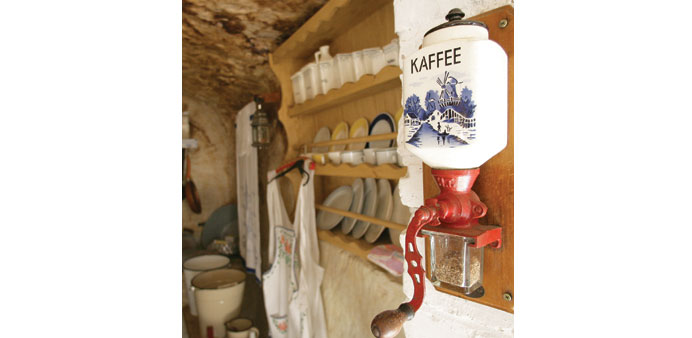
The cosy cottages are often dubbed u201ccliff villasu201d but their origins were a grim matter.