


By Ayman Adly/Staff Reporter
Two firefighting boats, which are being locally manufactured at the Coasts and Borders Security Department (CBSD) shipyard, are expected to be launched by the end of this year.
The new additions will boost the capabilities of CBSD in dealing with fires at sea, in particular in traditional dhows made of wood. The new vessels will enable CBSD personnel to limit the spread of any potential fire at sea. Such jobs are currently handled by the Civil Defence Department. The CBSD also plans to operate sea ambulances in the near future.
Staff Brigadier (Sea) Ali Ahmed al-Badeed, CBSD director, told media persons yesterday that the department maintained a 24-hour vigil on the national waters of Qatar and its coasts to ensure the security and safety of the country. He said that there are currently 14 different stations of the department distributed on various coastal locations throughout the country. Further, there are boats patrolling various key areas round-the-clock.
CBSD is expected to increase the number of its personnel and move into a new bigger location with more sophisticated facilities near Al-Daayen.
The current location has also introduced various sophisticated equipment, such as sea navigation simulators, for training its personnel. There are also studies to introduce ambulance boats to save the lives of people at sea. However, there is no timeframe for this project yet.
Brigadier al-Badeed stressed that fishing, in all its forms including rod fishing, is strictly prohibited at the Corniche area, which stretches from the Emiri Diwan up to the Sheraton roundabout. The same applies to swimming. Also speed boats and jet skiing are not allowed in this area.
“Some people do this because they do not know the rules, and they are instructed by CBSD patrols to avoid the area and move away. However, traditional dhows are the only vessels authorized to function in this area for tourist purposes.”
The senior official affirmed that those entering the Qatari waters illegally from the neighbouring countries for fishing are often arrested and referred to the court to deal with them accordingly.
“There is no room for mistakes and entering it unknowingly. Today, we have sophisticated GPS technology and various navigation tools that indicate clearly the border and the location of the boat. Further, I have seen people spreading around 300- 400 fishing traps, leaving them in the sea for some days and return for the same spot to collect the catch. These people could not be excused on their claim that they do not know,” he said stressing that Qatari waters is for the Qatari people there is no excuse for infringing upon its marine borders.
He explained that small commercial fishing boats are not allowed to go fishing unless the Qatari licensee is on board along with his workers. Yet, the rule is not applicable to big commercial vessels. However, hobby fishing at a small level is permissible in various coasts around the country.
“In Qatar, we have strict rules to preserve our marine environment and fish wealth; otherwise, our fish reserve would have decreased considerably as is the case in some countries. Also, fishing is not open throughout the year, it has well-defined seasons with certain regulations and specifications for fishing nets and gear,” he explained.
Brigadier al-Badeed talked passionately about sea life in Qatar in the past and the hard and thrilling pearl diving profession practised during old days. He said this is usually practised by some Qataris as a hobby now and “there is an annual pearl diving competition organised by Katara, where I took part and was one of the main winners”.
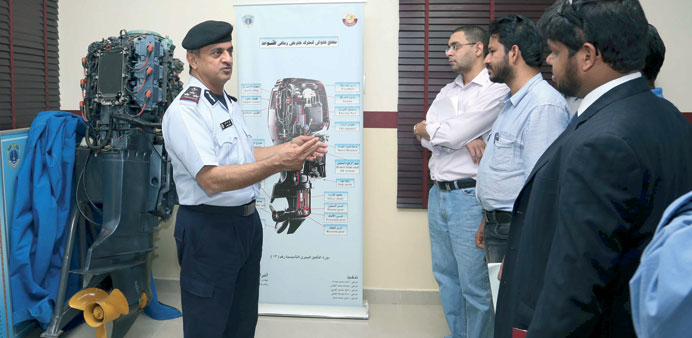
Brigadier al-Badeed explaining that boat drivers should have the basic technical training to know how their boats work.