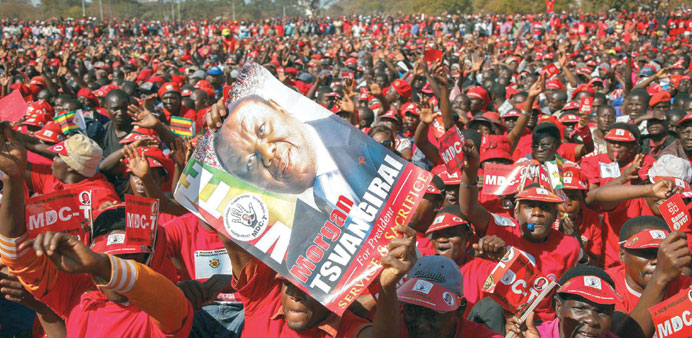
Thousands of MDC supporters attend the party’s last election rally outside the Harare Showgrounds.
DPA/Harare
Morgan Tsvangirai held yesterday one of the largest election rallies Zimbabwe has seen this year, urging supporters to back him for the presidency and oust President Robert Mugabe who has been in power since before most citizens were born.
“Mugabe belongs to the generation that was fighting for liberation. We belong to the generation looking for democratic change,” he told thousands of cheering supporters, who gathered under the hot sun for hours to listen to him and other party officials.
“Today’s problems cannot be solved by yesterday’s people,” said Tsvangirai, 61, who has been the 89-year-old Mugabe’s main rival since the late 1990s.
Many supporters of his Movement for Democratic Change hail the party platform of free universal basic education and plans to bring more foreign investment into the increasingly isolated nation.
Others, especially young people who account for the majority of the population want change in a country run by Mugabe’s Zanu PF since independence in 1980. They choose the MDC as a protest vote.
The economy has tanked in the last 15 years, in part owing to land grabs of white-owned farms and dismal economic policy which promoted rapid hyper inflation. At one point a 1tn Zimbabwe dollar bill was printed, though it too was effectively worthless.
Hundreds of thousands of skilled Zimbabweans live abroad, while foreign investors fear the country and the nationalisation programmes Mugabe backs.
After the disputed 2008 election, which saw the MDC targeted by state security forces, Mugabe and Tsvangirai formed a unity government often called a “marriage of inconvenience” which has failed to reform the country.
“The inclusive government was meant to try to demilitarise and depoliticise the country’s most important institutions and create a Zimbabwe election monitoring situation which is not one sided. Trying to create a level political field. This has not been achieved,” said Sabelo J Ndlovu-Gatsheni, a professor of African studies focused on Zimbabwe at the University of South Africa.
“For example, there is one dominant state run television station, one dominant radio station. There is not a fair playing ground.”
The security forces, who in the past have been involved in a host of politically motivated human rights abuses, have also not been reformed. Some generasl have sworn allegiance to Mugabe ahead of the poll.
But Tsvangirai, who was nearly killed by the Zanu-PF allied forces, said he would work with the security services if chosen as president.
“I am a survivor, beaten, incarcerated for no reason and treated like a common criminal. I am not bitter. I have reflected on what has been done to me and my family and I forgive my tormentors,” he told a cheering crowd.
Many of his supporters know the challenges the country faces. More often than not, the people in the crowd were jobless and said they did not see any hopeful prospects if Mugabe stayed in power.
Estimates say only 30% of the adult labour force is employed in the formal sector and many of them are civil servants.
“I like MDC’s policies, especially about job creation,” said Michael, a 27-year-old man from Harare who scrounges for odd jobs when he can.
“As MDC, we need a victory in this election. Mugabe makes a victim of everyone who opposes him. We need change,” he said, wearing his red MDC t-shirt.
David Chiwumbdira, 54 and a retired state employee, said the country was ready for a new leadership.
“The first priority of the MDC when they win must be to industrialise the country and create jobs. This is most important,” he said.
While he did not vote in 2008, this time Chiwumbdira pledged to cast his ballot in favour of Tsvangirai for president and the MDC for parliament and local government.
Mugabe held an election rally in Harare on Sunday, but notably many of his supporters were bussed in from other areas, some bluntly admitting they had shown up only for the free t-shirts.
One person said a Zanu-PF shirt would protect him on election day, highlighting how intimidation, which was rife in 2008, still has a lingering effect on the population.
Tsvangirai pledged that if he came to power, his detractors would have nothing to fear.
“After all this is done, I want Mugabe to enjoy a retirement in peace in his homeland.