


AFP/Nicosia
The left-wing Republican Turkish Party emerged as the largest party in a Turkish Cypriot parliamentary election on Sunday but will need to find a coalition partner on the right to command a majority.
The CTP took 38.49% of the vote, sharply up on its 2009 performance, giving it 21 seats in the 50-seat legislature of the breakaway Turkish Republic of North Cyprus, full provisional results showed yesterday.
The centre-left Communal Democracy Party (TDP) took 7.41% of the vote, giving it three seats.
But the CTP will still need to look to the centre-right Democratic Party (DP), which took 23.1% of the vote and 12 seats, or the nationalist National Unity Party (UBP), which took 27.16% and 14 seats, to form a majority administration.
Turnout was 70% among the 173,000 registered voters, roughly the same proportion as in 2009.
The result was a major blow for the UBP, which led the outgoing government but which lost a no-confidence vote on June 5 when eight of its own MPs defected over a privatisation programme it said was necessary to honour a 2010 austerity agreement with Turkey.
Ankara is a key aid donor and the only government that recognises the breakaway state which Turkish Cypriot leaders declared in the north of the Mediterranean island in 1983.
The DP has been the junior partner in coalitions with both major parties in the past but analysts said a grand coalition between the CTP and its nationalist rival was not to be excluded.
“Our people have entrusted us with the task of forming a government. We are going to assess the situation in the coming days,” said CTP leader Ozkan Yorgancioglu.
The new administration will in any case have to cohabit with nationalist president Dervis Eroglu, whose five-year term runs until 2015.
Eroglu called on Sunday for an urgent dialogue between the rival parties.
“I think these elections are an opportunity to begin such a dialogue straight after the vote,” he told reporters.
Analysts said cohabitation with the CTP could prompt an easing of Eroglu’s tough stance in talks with the Greek Cypriots in the south on ending the Mediterranean island’s nearly four-decade division.
Eroglu met Greek Cypriot leader Nicos Anastasiades, president of the internationally-recognised Republic of Cyprus, for a UN-hosted get-together in early June but substantive talks have been on hold for a year.
The CTP was a strong supporter of a UN-brokered reunification plan that was backed by Turkish Cypriots but rejected by Greek Cypriots in simultaneous referendums in 2004.
The outcome resulted in Cyprus joining the European Union that year still a divided island and the Turkish Cypriots being denied the full benefits of EU membership.
As a result, the north has remained heavily dependent on Turkish aid and a programme of public sector wage and recruitment freezes and tax hikes that Ankara has demanded in return dominated the election campaign, rather than the stuttering reunification talks.
Anastasiades has ruled out any resumption of the talks before October as his government pushes through swingeing austerity measures of its own that were demanded by international creditors in return for a 10bn-euro ($13bn) debt bailout.
Cyprus has been divided into Greek- and Turkish-Cypriot sectors since 1974 when Turkish troops invaded its northern third in response to a short-lived coup in Nicosia aimed at uniting the island with Greece.
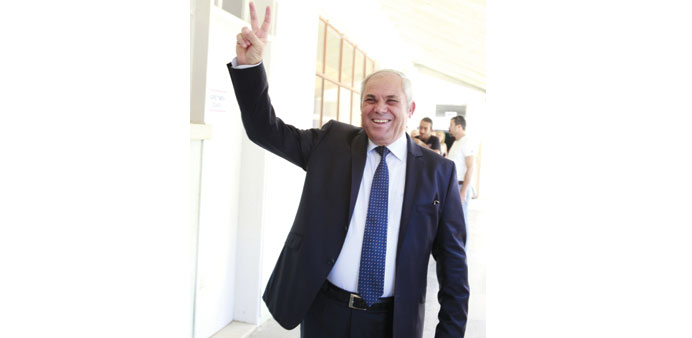
Yorgancioglu