


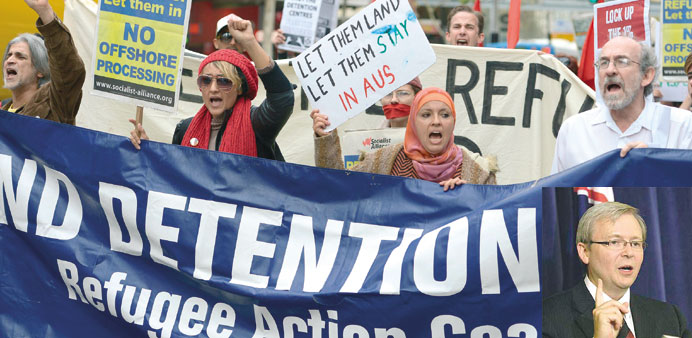
Pro-refugee protesters in Sydney yesterday. Inset below: Premier Kevin Rudd.
AFP/Sydney
Australian Prime Minister Kevin Rudd said yesterday he made “absolutely no apology” for his hardline new policy of sending asylum-seekers to Papua New Guinea as hundreds protested in Sydney.
Under the directive, those who pay people-smugglers to arrive on unauthorised boats will be sent to the poor Pacific nation for processing and resettled there—even if judged to be genuine refugees.
“On the question of asylum-seekers... we’ve had to adjust our policy over time and I make absolutely no apology whatsoever for our current policy settings because the world around us has changed,” Rudd told Channel Ten.
Rudd, who was last month reinstalled as prime minister by his Labor colleagues to help turn around dire opinion polls in an election year, had previously softened some of the former conservative government’s policies.
But after being reappointed leader, he moved quickly to announce a radically reshaped immigration plan under which boatpeople could be resettled in PNG, sent home or to a third country—but not to Australia.
The plan has worried the UN refugee agency, which said Friday that conditions at Papua New Guinea’s Manus Island facility currently failed adequately to protect refugees.
“UNHCR is troubled by the current absence of adequate protection standards and safeguards for asylum-seekers and refugees in Papua New Guinea,” it said in its first assessment of the policy.
Hundreds took to the streets in Sydney to protest the policy yesterday, carrying placards such as “Let them land, let them stay”, and at one point sitting at a major intersection and blocking it.
“Kevin Rudd has gone too far,” said Ian Rintoul from the Refugee Action Coalition.
“And he has misjudged the sentiment of the Australian community.”
Australia resumed sending asylum-seekers to Manus Island and the Pacific state of Nauru in 2012 to try to deter record numbers arriving by boat, hundreds of whom drowned en route.
Rudd has said the new PNG policy will take some time to deter asylum-seekers. Since he announced the change just over a week ago officials have intercepted 15 boats carrying some 1,250 people.
“It is the implementation of that policy direction over time, resolutely, which will yield results,” he told Network Ten’s Bolt Report.
“In the interim, people-smugglers will test your resolve.”
Asylum-seekers are a sensitive issue in Australia, and one set to feature prominently in the election due this year.
A Galaxy poll of more than 1,000 voters published in The Sunday Telegraph found that not only had Labor’s vote improved under Rudd, he was also rated as better at handling the asylum-seeker issue.
Rudd outscored opposition leader Tony Abbott 40 to 38% on the asylum-seeker issue in a poll taken after the PNG policy had been announced and publicised widely by the government.
The opposition leader said he was not worried about the poll—which put Rudd and Abbott’s parties at 50:50 - and said the PNG plan was yet to go into action as no new asylum-seekers had been sent to Manus.
“He is just not fair dinkum. That’s why, in any contest of wills between Mr Rudd and the people-smugglers, the people-smugglers think they will win,” Abbott told reporters.
But Rudd said while people-smugglers, who make thousands of dollars bringing asylum-seekers to Australia, would test the government’s resolve “we are not for turning”.
“Our policy is very clear... you will not be settled in Australia,” Rudd said.
Australian Prime Minister Kevin Rudd has made a surprise visit to troops serving in Afghanistan, telling them that it was time they came home. Rudd, who the Labor Party reinstalled as leader four weeks ago ahead of this year’s election, made the trip Saturday with his wife Therese Rein to troops in southern Uruzgan province.
“On behalf of a grateful Australian nation I am here to say to you, the men and women of the Australian Defence Force, thank you for a job well done,” Rudd told soldiers at the Tarin Kowt base.
“I say... thank you, and it’s about time we brought you home.”
Rein, the first wife of an Australian prime minister to visit a war zone, was briefed on aid work and said she was proud to meet the soldiers. Australia is preparing to wind down its deployment to Afghanistan after entering in late 2001, in the wake of the September 11 attacks on the US. “When the flag of Australia is brought down for the last time a few months from now, you will have been a part of history,” Rudd told the troops. Canberra has had some 1,550 in the war-torn country but the bulk will be brought home by the end of the year and the Tarin Kowt base handed over to Afghan authorities.
About 300 Australian military personnel will remain in the country after that, as advisers and trainers based in Kabul and Kandahar.
Forty Australian soldiers have died in the conflict, the latest a special forces soldier who was killed by small arms fire in June.
One soldier told the Australian Broadcasting Corp he was “very honoured” that Rudd, who is under pressure to call an election, had made the visit. “He’s actually taken the time out of his very busy schedule to come and do that for us, it’s fantastic, 100% support from Australia... makes you a very proud Aussie,” he said.
Australia has said it will continue to provide assistance and training to Afghan local forces beyond 2013 and has left open the possibility of a continuing role for special forces beyond the end of their current mission in 2014.