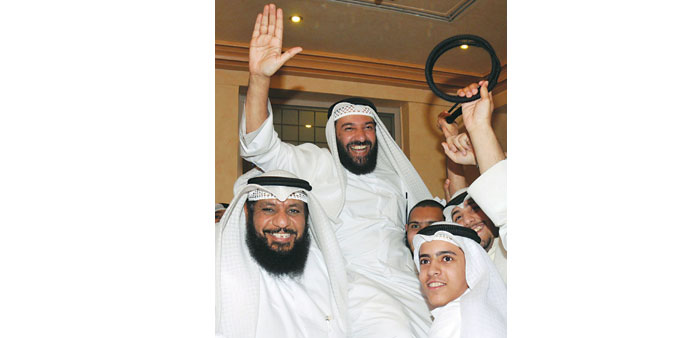
Candidate Ali al-Omair (centre) celebrates with his supporters following his victory in the parliamentary elections in Kuwait City early yesterday.
Agencies/Kuwait
Kuwait’s Shia minority lost more than half of their seats and liberals made slight gains in the country’s second polls in eight months, in a major blow to radicals.
The final results, released early yesterday by judicial authorities, showed Shia candidates winning just eight seats in the 50-member parliament.
Shia candidates had won a record 17 in the previous house elected in December but scrapped in a court ruling last month. Shias form around 30% of Kuwait’s native population of 1.23mn.
The official figures also recorded a significant rise in turnout.
According to figures posted on the information ministry website, voter turnout was 52.5%, compared to December’s record low of 40% due to an opposition boycott. Average turnout at Kuwaiti polls is around 65%.
Some groups who had boycotted the previous polls chose to take part this time, in particular Bedouin tribes and liberal groups.
“I think that the main success in this election is the failure of Shia and Sunni radicals to get re-elected,” director of Etijahat Research and Studies Centre Talal al-Kashti said.
At least two Shia and two Sunni religious radicals, who were accused of inciting sectarian tension, failed in their bid for re-election.
“The composition of this parliament is representative of various components of the Kuwaiti society. Accordingly, I believe it will be very quiet ... and will co-operate with the government,” said Kashti.
Liberals, Shias, Sunni Islamists, merchants and almost all Bedouin tribes have representatives in parliament.
The liberals, who had no seat in the previous parliament, won at least three this time. Sunni Islamists increased their presence from five to seven seats and tribal groups have maintained their strength of 24 seats.
“The election results are surprising as a number of veterans lost their seats in favour of young MPs. There was a big retreat for controversial figures,” political analyst Madhi al-Khamees wrote on his Twitter account.
Kashti said unlike the previous six parliaments which were dissolved due to political disputes, “it looks promising this parliament could complete its four-year term.”
The higher turnover came despite sweltering summer heat as the mercury hit 45 degrees Celsius; Ramadan fasting; and calls by the opposition to boycott the ballots.
Only two women were elected compared to three in the previous parliament.
And the new parliament includes as many as 26 new faces, reflecting the desire of Kuwaiti voters for change in the hope of an end to ongoing political crises.
The opposition had called for a boycott in protest against the government’s amendment of the key electoral law, even though it was upheld by the constitutional court.
The opposition says the amendment enabled the government to manipulate the outcome of polls.
Kashti said it appears from the election results and voter turnout that the opposition had lost some of its popular appeal.
Saturday’s ballot was the sixth since 2006 in Kuwait, where political upheaval and bureaucracy have held up the vast majority of projects in a 30bn-dinar ($105bn) economic development plan announced in 2010.
Parliaments have been repeatedly dissolved over procedural disputes or for challenging the government.
In accordance with Kuwait’s legislation, the outgoing cabinet approved a draft decree inviting new lawmakers to hold their first parliamentary session on August 6, state news agency Kuna said.
The outgoing prime minister has also sent the government’s letter of resignation to the emir, as is the norm following a new parliamentary vote.
“The country is reeling from the deterioration of services and we need to treat the wounds to start a new phase with genuine co-operation between the two authorities,” new MP Issa al-Kandari said, referring to the government and parliament.
Newly-elected Kamel al-Awadi said he would “work on all projects that move the economy forward” including housing and infrastructure projects. Many of these were touted in the 2010 development plan and have not been delivered.