


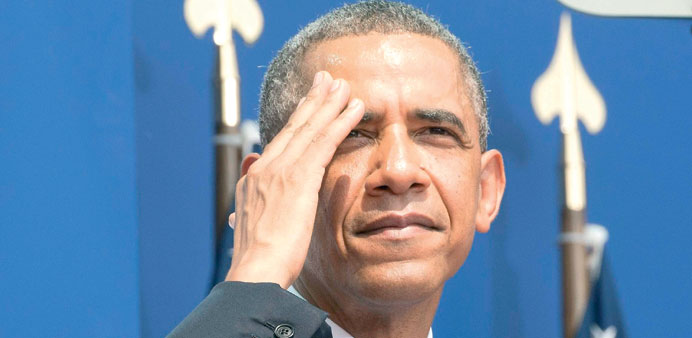
President Barack Obama wipes his brow as he delivers remarks marking the 60th Anniversary of the Korean War Armistice at the Korean War Veterans Memorial in Washington, DC, yesterday.
AFP/Washington
|
|
The US president, marking the 60th anniversary of the end of the Korean War, said yesterday the armistice that left a sharp division between the communist north and capitalist south was not a “tie” but a “victory.”
Barack Obama’s remarks are a counterpoint to a ceremony in Pyongyang, where North Korean leader Kim Jong-Un unveiled a renovated Korean War museum with a US-baiting centrerpiece in the form of the spy ship USS Pueblo, captured in 1968.
The 1950-53 conflict essentially ended with North and South Korea occupying the same territory they held at the start, but the 1953 armistice is celebrated in the North as “Victory Day.”
In his remarks yesterrday at the Korean veterans memorial in Washington, Obama made the same claim for the South Korea-US side.
“Here, today, we can say with confidence that war was no tie. Korea was a victory,” he said.
“When 50mn South Koreans live in freedom - a vibrant democracy, one of the world’s most dynamic economies, in stark contrast to the repression and poverty of the North - that’s a victory; that’s your legacy,” he added.
The president lamented that US veterans from the Korean war came home to relative indifference: “Among many Americans, tired of war, there was, it seemed, a desire to forget, to move on.”
But he said, that was changing in recent years, in part with the construction of the monument, and he urged Americans to listen to veterans’ stories.
US Defence Secretary Chuck Hagel also spoke at the event, cheering the soldiers who “liberated millions of people from tyranny.”
“Together, we acted out a belief that peace and security among nations must depend upon the rule of law, not the rule of force,” Hagel said, citing alliances with South Korea, and in Europe, Asia and Africa.
The US was by far the biggest contributor to the multinational UN force that poured into South Korea to roll back a Chinese-supported invasion from the North.
Nearly 1.8mn US servicemen and women served in Korea, of whom 33,739 died in combat and more than 100,000 were wounded, according to the US Department of Veterans Affairs.
It was also the first war in which US forces were not racially segregated.
The conflict ended with a ceasefire, which was never cemented with a treaty, leaving the two Koreas still technically at war.