


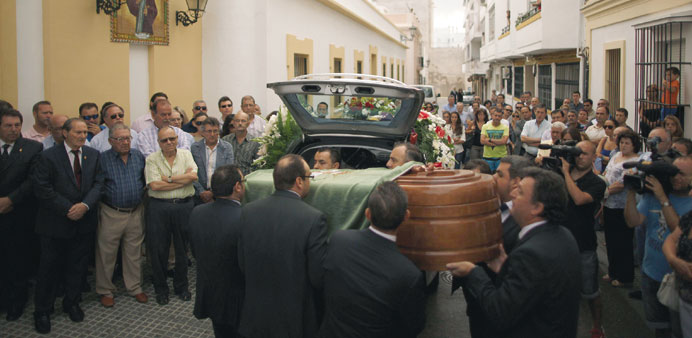
People carry the coffin of Ignacio Bustamante Morejon, one of the victims of Wednesday’s train crash in Santiago de Compostela, outside the Divina Pastora church in San Fernando, near Cadiz in southern Spain.
AFP/Santiago de Compostela, Spain
The driver of a train that hurtled off the rails killing 78 people in Spain faced possible charges of “reckless homicide” as the northwestern city of Santiago de Compostela, where the crash occurred, prepared a memorial service for the victims in its cathedral, a destination for Catholic pilgrims from around the world.
Police detained the driver of the train – who reportedly boasted of his love for speed online – on Thursday “for the alleged crimes of reckless homicide”, Interior Minister Jorge Fernandez Diaz told reporters yesterday during a visit to the city.
The driver, Francisco Jose Garzon Amo, 52, refused to answer police questions on Friday in his hospital bed where he reportedly received stitches for a head injury and the case was passed to the courts.
He was taken to a police station yesterday after being discharged from hospital and will appear before a judge today who will decide whether to press formal charges, the interior minister said.
“There are reasonable grounds to consider that he may have been responsible for what happened, which must be established by a judge and the investigation which has been opened,” Fernandez Diaz said.
Under Spanish law, a suspect can be detained for a maximum of 72 hours before being heard by a judge.
The train’s data recording “black box” is in police hands but still has not been analysed, Public Works Minister Ana Pastor said.
The train was said to have been travelling at more than twice the speed limit on a curve when it hurtled off the rails and slammed into a concrete wall, with one carriage leaping up onto a siding.
Smoke billowed from the gutted cars as bodies were strewn across the tracks about 4km from the station at Santiago de Compostela.
Locals said they came running from their houses to drag passengers from the wreckage.
Spanish media published photographs of the man they identified as Garzon Amo after the crash, with blood covering the right side of his face.
The driver should have started slowing the train before reaching a bend that train drivers had been told to respect, the president of Spanish rail network administrator Adif said.
“Four kilometres before the accident happened he already had warnings that he had to begin slowing his speed,” Gonzalo Ferre told Spanish public television TVE.
Seventy-eight passengers died and 178 were injured, regional authorities said.
At least seven foreigners were among the dead – a US citizen, an Algerian, a Mexican, a Brazilian, a Venezuelan, an Italian and a national of the Dominican Republic, a judicial source said.
Most of the injured were Spanish but at least eight were foreigners from Argentina, Britain, Colombia, the United States and Peru.
Many of the passengers in Wednesday’s crash were said to be on their way to a festival in honour of St James, the apostle who gave his name to Santiago de Compostela.
The driver, while still trapped in his cab, told railway officials by radio that the train had taken the curve at 190kph, more than double the 80kph speed limit on that section of track, El Pais said, citing unidentified sources in the investigation.
“I was going at 190! I hope no one died because it will weigh on my conscience,” he was quoted as saying.
State railway company Renfe said the driver had been with the firm for 30 years, including 13 years as a driver.
He had driven trains past the spot of the accident 60 times during his time with Renfe, company president Julio Gomez-Pomar told private television Antena 3.
“That is to say, the knowledge that he has to have of this track is exhaustive,” he said.
Media reports described Garzon Amo as a speed freak who once posted a picture on his Facebook page of a train speedometer at 200kph.
A caption read: “I am on the edge, I can’t go faster or else I will be fined.”
The page has since been taken down.
Renfe said the train – a model able to adapt between high-speed and normal tracks – had no technical problems and had just passed an inspection on the morning of the accident.
Experts have raised questions about the track’s speed signalling system.
Since high-speed trains use the route, it has been equipped with an automatic speed control system known as the European Rail Traffic Management System, under which a train’s brakes can be automatically applied if speeding.
But the secretary general of Spain’s train drivers’ union, Juan Jesus Garcia Fraile, told public radio that the system was not in place at the crash site.
It was Spain’s deadliest rail accident since 1944 when hundreds were killed in a train collision, also between Madrid and Galicia.
In 1972, 77 people died when a train derailed between Cadiz and Seville.
“It gives you the shivers to think of everything that people experienced here that terrible night,” said local resident Celia Rosende as she looked at the damaged carriages still lying on the rails.