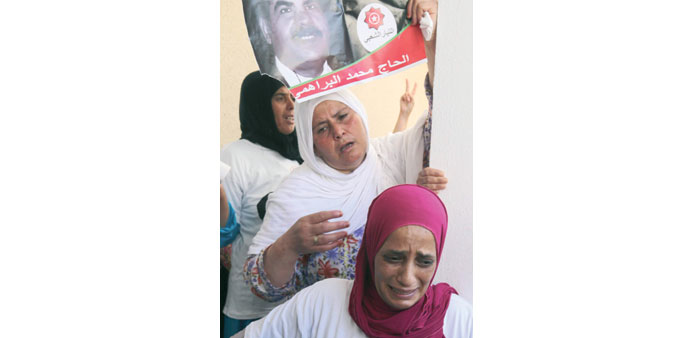
Family members of assassinated opposition politician Mohamed Brahmi hold his poster as they mourn during his funeral procession in Tunis yesterday.
AFP/Tunis
Thousands of Tunisians took to the streets yesterday for the funeral of an opposition leader assassinated with the same weapon that killed a colleague, as tensions soared after anti-government protests.
After the funeral, protesters marched on the National Assembly and clashed with riot police who fired teargas to disperse them.
Draped in the red and white Tunisian flag, Mohamed Brahmi’s coffin was saluted by soldiers as the cortege left his home in the Tunis neighbourhood of Ariana for El-Jellaz cemetery.
Emotions ran high as supporters of Brahmi, who included members of his family, lifted the coffin to their shoulders before placing it on a military vehicle given an armed escort.
A military helicopter overflew the capital as a sea of flags fluttered among the crowd waiting for the funeral procession along Habib Bourguiba Avenue, epicentre of the 2011 Arab Spring.
Slogans vowing they will “avenge” Brahmi rose from the sea of mourners.
Police deployed reinforcements for the funeral which was attended by some 10,000 mourners, according to police estimates. Journalists gave a higher number of 15,000-20,000.
“Allahu akbar!. There is no God but Allah and martyrdom is his friend,” mourners cried out at El-Jellaz cemetery.
Army chief of staff General Mohamed Salah Hamdi read the eulogy and an imam prayed, but there were no representatives from the ruling Islamist Ennahda party which the family blames for Brahmi’s murder.
His widow Mbarka, who wore a headscarf, made the V-for-victory sign.
“The people want the fall of the regime,” and “Ennahda terrorist gang,” the crowd shouted, before falling silent for the national anthem.
The coffin was then lowered into a grave in the “martyrs” sector of the cemetery next to that of leftist politician Chokri Belaid, in accordance with his wishes.
After the funeral youths demanding “the fall of the government today!” marched to the National Assembly and hurled rocks and other projectiles at anti-riot police who responded with teargas.
Overnight 42 opposition MPs announced they were pulling out of the assembly, saying parliament must be dissolved and a government of national unity set up.
Brahmi, 58, was shot dead outside his home on Thursday with the same weapon used to gun down Belaid in February, Interior Minister Lotfi Ben Jeddou said.
Hours before the funeral got under way, a bomb exploded near a police post in the port of Tunis yesterday, damaging a police jeep but causing no injuries, the interior ministry said.
A resident said the blast, the first known attack of its kind against a military vehicle in Tunisia, slightly wounded a policeman and caused panic among some residents of La Goulette district.
The bombing comes a day after a general strike called by the powerful General Union of Tunisian Labour (UGTT) and an anti-government demonstration during which one person was killed.
Brahmi was an MP with the leftist and nationalist Popular Movement but on July 7 quit the party he founded, saying it had been infiltrated by Islamists.
The state prosecutor’s office said an autopsy found Brahmi had been hit by 14 bullets and authorities blamed extremists with links to Al Qaeda.
Balkis Brahmi, 19, one of Brahmi’s five children, said he had been killed by two men in black on a motorbike.
“At around midday, we heard gunfire and my father crying with pain. We rushed out—my brother, mother and I—to find his body riddled with bullets at the wheel of his car parked in front of the house,” she said on Thursday.
Beji Caid Essebsi, head of the Nidaa Tounes party, had said Ennahda was to blame for Brahmi’s assassination because it had failed to identify Belaid’s killers.
“There has not been any serious judicial action,” he said.
Ennahda chief Rached Ghannouchi, in a statement to AFP on Thursday, said Brahmi’s killing was a “catastrophe” for Tunisia and said those responsible wanted to drag the country into civil war.
The UN human rights office urged official restraint in the face of public anger.