


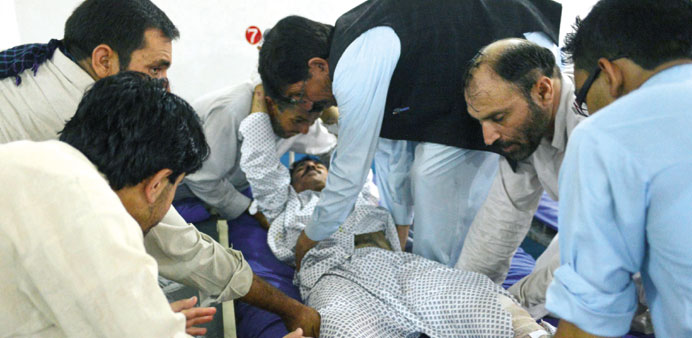
Pakistani paramedics carry a bomb blast victim at a hospital in Peshawar yesterday, who was injured at attacks at the bazaar in Parachinar. The death toll from twin suicide attacks at a busy marketplace in northwest Pakistan has risen to 57, officials said.
Agencies/Islamabad
|
|
The death toll from a pair of co-ordinated suicide bombs targeting Shias in a volatile Pakistani town near the Afghan border rose to 57 overnight, officials said yesterday, in one of the worst sectarian attacks in the country in months.
Tensions between Shias and Sunnis have risen in past years, with radical Sunni Islamist groups frequently attacking Shias whom they see as heretics.
On Friday evening, two suicide bombers on motorcycles struck in the northwestern town of Parachinar just as people flocked to a busy marketplace to buy food for their evening meals after a day of fasting during the holy month of Ramadan.
Riaz Mahsud, the top administrator of the predominantly Shia Kurram area, said the death toll, originally reported at 39, jumped to 57 after several people died from their wounds during the night. He said all the victims were Shias.
A previously unknown group called Ansarul Mujahideen claimed responsibility for the attack.
“We plan more similar attacks against the Shia community in Pakistan to seek revenge for the brutalities of Shias against Sunnis in Syria and Iraq,” Abu Baseer, who identified himself as a spokesman for the group, said by telephone.
Parachinar is home to a significant Shia community which has been previously targeted by militants. Shias make up a little over 10% of Pakistan’s population of 180mn.
Separately, gunmen attacked a coastguard checkpost in southwestern Pakistan yesterday, killing seven officials and wounding seven others, officials said.
The incident happened in the Suntsar area of Gwadar district, 1,420km southwest of Quetta, the capital of the oil and gas rich Baluchistan province that borders Iran and Afghanistan.
“Around 24 gunmen armed with rockets and heavy weapons, attacked the checkpost and killed seven coastguard officials,” provincial home secretary Akbar Hussain Durrani said.
He said at least seven coastguard officials were also injured in the early morning attack.
A local tribal police official Mohamed Ali also confirmed the attack and casualties and said the identity of the attackers was not immediately known.
Baluchistan suffers from both Islamist militancy and a regional insurgency which began in 2004, with rebels demanding political autonomy and a greater share of profits from the region’s natural resources.
The province has also increasingly become a flashpoint for surging sectarian violence between Pakistan’s majority Sunni and Shias.
Elsewhere in the northwestern town of Tal that borders the restive North Waziristan tribal region, at least two paramilitary Frontier Corps (FC) soldiers were killed and 25 others wounded in an attack on their checkpost yesterday.
“Around 50 militants attacked an FC checkpost and exchanged fire with the soldiers for over two hours, which killed two FC soldiers and wounded 25 others,” a local intelligence official said on condition of anonymity.
Another intelligence official also confirmed the incident and said that the attack was repulsed after FC troops retaliated.
He added that 18 militants were killed in retaliatory fire by the FC .
The northwestern Khyber Pakhtunkhwa province is on the frontline of a seven-year Taliban insurgency and abuts the semi-autonomous tribal belt, where US drone strikes target Taliban and Al Qaeda operatives.
Washington considers the tribal areas a major hub of Taliban and Al Qaeda militants plotting attacks on the West and in Afghanistan.
Tackling homegrown Islamist militancy is one of the major tasks for Pakistan’s new government, which was sworn in earlier last month after the elections.