


By Steff Gaulter
|
|
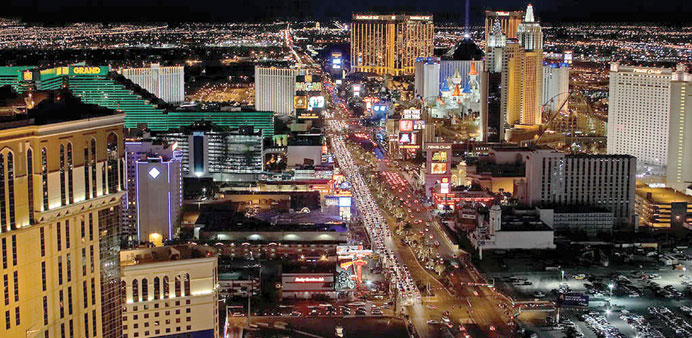
Las Vegas might be known as the entertainment capital of the world, but literally translated it means ‘The Meadows’. It may seem a strange title for a city in the middle of a desert, but in the 1800s, the city was a natural oasis, with springs and grasslands. People used to stop at springs to fill up their bottles with water when they were travelling from Texas to Los Angeles. Nowadays, things have changed dramatically. The city largely comprises cement and tarmac, with a population in the urban zone of nearly 2mn, approximately the same size as Doha’s population.
The climate of Las Vegas is also fairly similar to Doha’s; it’s hot and dry. Doha expects 75mm (3 inches) of rain in a year, whilst on average Las Vegas receives 105mm (4.1 inches). The majority of this rain falls from thunderstorm clouds. However, unlike Qatar, Las Vegas doesn’t expect the entire summer to be bone dry, and in the last week it has been anything but dry.
On July 20, a gust of wind of 114kph (72mph) blew down trees and power lines, leaving thousands of people without power. For a couple of hours, rain poured down across the city. The ground in Las Vegas is similar to that in Doha. It’s mostly cement and tarmac, so there’s nowhere for the rain to go. Also the ground is baked hard by the sun, so any soil won’t be able to absorb water readily; it’s forced to sit on the top and form vast puddles. Although only 5.6mm (0.22 inches) of rain fell in Las Vegas, this was enough to cause flooding.
Just a few hundred kilometres away, a huge wildfire was raging. Wildfires are so common in the US that they are given names to help them distinguish from each other. The Mountain wildfire was burning just 3km (2 miles) away from the town of Idyllwild. A mandatory evacuation order was placed on the town, forcing thousands to leave their homes.
Wildfires and flooding might seem as different as chalk and cheese, but they are often both caused by the same thing, namely thunderstorms. Storms have been raging across the southwestern parts of the USA over the last few weeks. It was these which triggered the torrential rain that that caused both the flooding in Las Vegas, and also the lightning which sparked the wildfire in California.
Sometimes both events can happen in quick succession, which can either be a blessing or a curse.
In the case of the Mountain Fire, the rains poured as the fire was still raging. This greatly helped the firefighters contain the fire, and no doubt saved the homes of those living in the region. However, in Colorado things were a little different. Video footage showed a car being swept away by filthy, muddy flood waters.
The pouring rain fell on a region which had been ravaged by a wildfire a few days earlier. This meant there was nothing on the landscape to stop the rainwater from hurtling down the mountainside. The combination of wildfires and torrential rain made things far worse than the sum of the individual events.
Although in general, the Southwestern USA is a dry part of the world, thunderstorms at this time of year aren’t out of the ordinary. In fact, this is another part of the world that has its own monsoonal climate. The word ‘monsoon’ comes from the Arabic for season and simply means that there is a reversal of wind direction. We have something of a monsoon climate in Doha: in the winter we have the cold northwesterly wind, called the Shamal, and in the summer the southerly winds bring us our unbearable humidity.
The monsoon in North America may not have the same global fame as the Indian monsoon, but it’s just as dramatic for the people who live in the region. It’s also generated by the same phenomenon; the heat of the summer sun. As the temperatures across the region soar, the air over the mountains of northern Mexico and the southwestern USA rises. To take its place, air rushes in from the Pacific. This air is laden with water.
The rain first falls first over Mexico, then spreads northwards along the western slopes of the mountains, the Sierra Madre Occidental. The rain normally starts in Mexico at the beginning of June, but it’s not until early July that rain can be expected to reach Arizona and New Mexico.
As the rains push northwards, their intensity eases. The most dramatic impact is therefore in Mexico, where over 300mm (12 inches) of rain in a single month can transform the scenery from desert to tropical rainforest in a matter of weeks.
Even in Arizona, about half of the annual rain falls during the monsoon season. The thunderstorms here can normally be seen building over the mountains from about lunch time. They then unleash their rain and lightning over the higher ground in the afternoon and evening, before rumbling their way westwards overnight.
The strength of these storms should not be underestimated. They can trigger violent flash floods, thousands of lightning strikes, destructive hail, and walls of damaging winds. Despite this, some residents look forward to the rains, for the simple reason that they also reduce the temperature. The temperature in the southwestern parts of the USA is often as high as in Qatar; the average temperature in Phoenix, Arizona is 41.1oC (106oF), whereas in Doha it is 41.5oC (107oF). Suddenly longing for a thunderstorm makes perfect sense!
Arizona and Qatar both have similar heat in the summer, and both have a monsoon climate. The big difference is in the amount of rain. If there were a chance of a thunderstorm, I’d certainly take it, even if it did come with the threat of flash flooding.
(The author is Senior Weather Presenter at Al Jazeera English channel. She can be contacted on [email protected]
or on Twitter at @WeatherSteff)