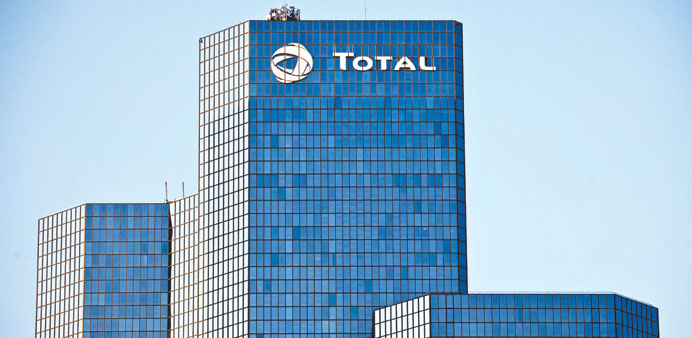
French oil group Total reported a 67% boost to net profit in the second quarter to €2.5bn ($3.3bn), but said yesterday this was driven mainly by special factors.
The group also reported the biggest increase in production of hydrocarbons for three years.
Excluding non-recurrent items, net profit fell by 3.0% to €2.7bn.
But this non-recurrent outcome was slightly higher than the figure of €2.67bn expected by analysts polled by Dow Jones Newswires.
The special factors covered exceptional gains and a favourable effect of stock valuations.
The fall of the underlying profit figure reflected a fall in oil prices on a 12-month basis, although the setback to the results was less than the decline of the oil price.
The average price of Brent quality North Sea oil fell by 5% between the two comparable periods, from $108 to $102.
The group also reported figures showing that it had withstood pressures in the refining and distribution chains, even though refining margins in Europe fell by 40% in the quarter.
The theoretical calculation by the group of margins for the sector in Europe fell to $24.1 per tonne of refined crude oil from $38.2 12 months earlier.
The key feature of the group’s performance in the quarter was the expected rise of production of hydrocarbons after more than a year of falling output.
In the quarter, production rose by 1.3% to 2.29mn barrels per day, in line with estimates by analysts. This was the biggest increase since 2010.
Samsung
Samsung Electronics, the world’s largest technology firm by revenue, yesterday posted another record quarterly net profit, but weakening earnings momentum has fuelled fears over flagging demand for high-end smartphones.
The South Korean giant said its April-June net profit surged 49.7% year-on-year to 7.77tn won ($6.96bn) thanks to robust shipments of its flagship Galaxy S smartphones and higher chip prices.
Second-quarter operating profit surged 47.5% on-year to 9.53tn won in the same period as sales grew 20.7% on-year to 57.46tn won.
The figures were in line with the firm’s forecast at the start of the month, although they were well short of expectations, which had been for an operating profit of 10tn won.
Samsung’s share price has been falling — wiping about $30bn off the firm’s value — since late April when the flagship Galaxy S4 hit stores, as sales have not been as high as hoped.
That is despite the company spending billions of dollars on a global marketing campaign, squeezing margins, after launching the latest gadget at a lavish New York event in late March.
For Samsung the IT and mobile sector contributed most of the second-quarter operating profit, producing 6.28tn won, up 52% from a year earlier.
Semiconductors saw a 1.76tn won operating profit, up 71% from a year earlier, while operating profit from displays surged 58% year-on-year to 1.12tn won.
Wipro
Wipro, India’s third-largest software services exporter, sounded upbeat about demand for its outsourcing services, after posting an 11% rise in quarterly net profit helped by an increase in large contracts.
The company expects revenues from IT services business for the current quarter that ends September 30 will range between $1.62bn and $1.65bn, a sequential increase of 2% to 3.9%.
Most analysts were expecting the company to say sales in the current quarter would rise 1-3%. Wipro does not give an annual forecast.
Consolidated net profit for the fiscal first quarter ended June 30 rose to Rs16.23bn ($275mn) from 14.66bn rupees a year earlier, Bangalore-based Wipro said after market close yesterday.
That compares with the Rs16.3bn average of 21 analyst estimates according to Thomson Reuters I/B/E/S for the company, whose customers include Citigroup, Apple and Cisco Systems.
IT services revenue rose 0.2% from the January-March quarter to $1.59bn. It added 28 new clients during the quarter.
Renault
French auto group Renault reported a profit plunge yesterday owing to charges for halting its activities in Iran and for restructuring in France.
The group reported a net profit for the first six months of the year of €39mn ($52mn) compared with €746mn at the same time last year.
The exceptional charges helped to push the operating result to a loss of €249mn from a profit of €519mn last time.
The price of shares in the group rose by 3.70% to €61.89 despite the profit drop because the board stood by its outlook for the year, market sources said.
The overall French market as measured by the Cac 40 index was up 1%.
Sales fell by 2.4% to €20.4bn, the group said in a statement, but it stood by its outlook for the full year despite what it termed a “tougher environment than expected.”
The company took a charge this year of €512mn for its activities in Iran which have been hit by a hardening since July 1 of international sanctions which now include the auto sector.
Kia Motors
South Korea’s second-largest carmaker Kia Motors said yesterday its second-quarter net profit jumped 7.8% from a year earlier on the back of brisk overseas sales — mainly in China.
Net profit in the April-June period surged to 1.18tn won ($1.06bn) from 1.09tn won a year ago.
Sales were up 4.5% year-on-year to 13.1tn won, while operating profit fell 8.5% to 1.1tn won.
China accounted for some 19% of total sales in the quarter.
But the company warned that falling growth in car sales world-wide, a possible ending of quantitative easing in the US and a slowing Chinese economy posed risks for the rest of the year.
Kia said it would increase prices to improve profitability, while it also plans to launch two models at home and increase purchase incentives for current models in China.
Piaggio
Italian motorcycle and scooter maker Piaggio’s first-half sales fell 12% to their lowest since 2004 and net profit tumbled 25% as Europe’s five-year motor industry slump persists.
The maker of Vespa scooters said the strength of its brand as well as cutting back on investment and other costs allowed it to maintain its EBIT profit margin at 15%, matching 2012.
Demand in Asia was flat but it would push ahead with plans to boost sales there to 50% of the total to offset the European decline as outlined in its 2011-2014 business plan, it said. Piaggio has missed revenue targets for several years.
In Italy, where Piaggio has a 25% market share, two-wheel vehicle sales have fallen 53% over the last six years to 206,422 in 2012, according to trade group ANCMA.
Consolidated sales for the first half were €671.5mn ($888.8mn), net profit was 24.9mn, and EBITDA was 100.6mn, down from 114.4mn euros last year.
Hindustan Unilever
India’s biggest consumer goods maker Hindustan Unilever, the local arm of food giant Anglo-Dutch Unilever, reported yesterday a 23% slide in quarterly net profit and voiced worries about weak market growth.
Net profit fell to Rs10.19bn ($172mn) in the three months to June from Rs13.31bn a year earlier, which was higher due to a one-time gain from the sale of property — broadly in line with market estimates.
Sales in the financial first quarter rose just 7% to Rs66.87bn after climbing 14% in the same quarter the previous year, the company — which sells brands such as skin fairness cream Fair and Lovely, Dove products and Lux soaps — announced.
Concern about Hindustan Unilever (HUL) sales growth, which are watched by analysts as an indicator of overall Indian consumer demand, sent the company’s shares down 3.38% to Rs663.3.
This month, Unilever announced it had paid $3.2bn for an additional 14.8% stake in its Indian subsidiary as part of its strategy of expanding in emerging markets.
Unilever now owns 67.28% of HUL, up from an earlier 52.48%. India is Unilever’s third-largest market.
The company said that sales of personal care products edged up much lower than the normal 2% in the quarter, soaps and detergents rose 8% while food items increased 12.5%.
Caixabank, Banco Popular
Bad debts rose in the first half of the year at Spanish lenders Caixabank and Banco Popular, weighing on their earnings even as income from lending began to show signs of improvement.
At Barcelona-based Caixabank, Spain’s third-biggest banking group, losses on deteriorating assets grew by more than 50% in the first half of the year despite having made hefty provisions last year against losses on troubled property assets.
The bank took a further €540mn ($715mn) hit in provisions against possible losses after reclassifying more of its refinanced loans as non-performing, under instructions from the Bank of Spain.
That pushed the ratio of bad loans in its credit book to 11.17% at the end of June, from 9.4% at the end of March.
While Caixabank benefits from government-funded protection against losses on some of its assets, after it bought bailed out lender Banco de Valencia, mid-sized Banco Popular does not.
Banco Popular’s bad loans ratio was 10.84% at the end of the first half, up from 9.94% at the end of March and 6.98% at the end of June 2012.
The bank said that growth in non-performing loans would slow in the coming quarters, though analysts still flagged this as a problem area for the bank, which posted net profit down 3% from a year ago.
Caixabank still managed to more than double net profit to €408mn, beating analysts’ expectations, though that was partly thanks to a large jump in trading gains on bonds.
Net interest income, a closely watched measure of income on loans, rose 10% from a year earlier. The lender’s acquisition of Banca Civica and bailed-out Banco de Valencia last year helped in this regard, but analysts said that underlying trends, such as falling deposit rates, also looked positive.
At Popular, which managed to ward off the need for state help last year through a rights issue, net interest income fell 13% on the same period last year. But the bank said net interest income in the second quarter had been up 11% on the first three months of this year.
Popular’s net profit fell 3% from a year ago to €170mn. It beat analysts’ expectations, also partly because of high trading gains.