


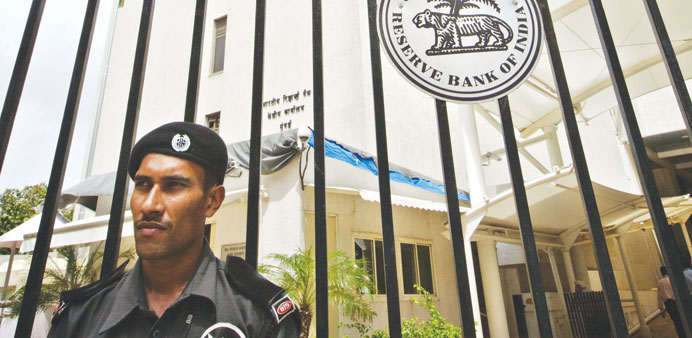
A security officer stands guard beside the Reserve Bank of India signage outside the central bank’s headquarters in Mumbai on Monday. A more significant test of the RBI’s rupee defence will come today when it is due to sell Rs150bn in government bonds.
Reuters/Mumbai
India’s defence of its currency is showing signs of working as the central bank pays the highest yields for short-term debt in years, although its resolve faces a bigger test today, at a sale of longer-dated bonds.
The rupee rose for a second session yesterday after the Reserve Bank of India agreed to pay double-digit yields to sell Rs52bn ($880.01mn) in one- and two-month debt, in its second sale of short-term debt in as many days.
Although the RBI fell short of its plan to sell Rs60bn of debt, investors saw the willingness to pay such high yields as an important sign of resolve after it last week rejected all bids in a treasury auction and then sold just over a fifth of longer-dated debt at a separate sale.
A more significant test of the RBI’s rupee defence will come today when it is due to sell Rs150bn in government bonds, after its surprise strategy to shore up the rupee by draining cash was unveiled two weeks ago and was followed up with more tightening measures on Tuesday.
Willingness to sell debt at higher yields will be essential if investors are to buy into the central bank’s plans after debt yields have shot up as a result of the RBI’s measures.
Although the central bank is unlikely to want to be held hostage by paying any yield demanded by investors, it will need to meet them at least some of the way, or risk a standoff with markets that imperils future debt sales.
“If these moves are seen to fail, the rupee could come under renewed pressure as markets would conclude that the policy resolve to anchor the currency is missing. For the sake of credibility, therefore, it’s important to stay the course,” financial services firm JP Morgan said in a note to clients.
The rupee rose yesterday and has now gained 1.7% since the RBI announced on Tuesday additional steps to drain cash, including constricting lenders’ access to central bank funds.
The measures came after the bank’s initial steps, announced on July 15, had failed to lift the rupee much above its record low of 61.21 hit earlier this month, as investors questioned the effectiveness of the RBI’s plan.
Those doubts are now starting to be dispelled. Yesterday the central bank sold Rs22bn in 28-day cash management bills by paying 11.18%, although that was less than the Rs30bn on offer.
The RBI sold its entire allocation of 56-day equivalents at 11.20%.
The rates paid were far above the yields paid at the RBI’s last cash management bill sale in November 2011, when it paid around 8% for 42-day bills.
Yesterday’s sale comes after the central bank paid the highest yields in at least six years at a separate sale of Treasury bills on Wednesday.
The RBI’s sale of Rs150bn of debt today, includes Rs30bn of 10-year bonds.
The RBI is likely to be mindful of over-paying for the debt, and saddling the country with high interest payments at a time when its fiscal deficit is a key concern for credit agencies, but it can’t afford a stand-off with already wary investors.
“The RBI’s intent is to make the cost of funding prohibitive,” said Suyash Choudhary, head of fixed income at IDFC Asset Management Co, adding that would discourage bond buying. “It’s reasonable to expect muted demand at the auction.”
Benchmark 10-year bonds have slumped since July 15, although prices recovered somewhat yesterday, sending yields down 19 basis points. Page 24