


AFP/Reuters/Santiago de Compostela, Spain
Near a bend in the track on the outskirts of the Spanish pilgrimage city of Santiago de Compostela lie the twisted, gutted shells of the train carriages.
One is rammed into a concrete siding, another snapped like a branch over the top of a third. Bits of twisted metal from a fourth are scattered nearby.
A few bodies wrapped in white sheets are lying along the tracks, waiting for emergency workers in orange and yellow vests to carry them away.
On a bank above the rail line, Maria Teresa Ramos sits in her front garden watching as two giant white cranes prepare to heave away the scrap from Spain’s deadliest train crash in decades.
She was in her house when the train hurtled off the tracks below on Wednesday evening.
“I heard something like a clap of thunder. It was very loud and there was lots of smoke. It’s a disaster,” the 62-year-old housewife told AFP, recalling how she and her neighbours ran outside to help. “People were screaming. I saw a train on top of the siding. No one here has ever seen anything like this.”
She and her friends ran for blankets and towels to help the survivors, while her neighbour Martin Rozas, 39, helped pull the wounded from the wreckage and laid blankets over the dead.
“It was like an earthquake,” he said. “I started helping pull people out. I saw about five people dead.”
Ana Taboada, a 29-year-old hospital worker, who lives opposite the railway embankment, was one of the first on the scene.
“When the dust lifted I saw corpses. I didn’t make it down to the track, because I was helping the passengers that were coming up the embankment,” she told Reuters. “I saw a man trying to break a window with a stone to help those inside get out.”
“My God, my God, how awful!” wails local resident Isidoro Castano, as he records the scene immediately after the crash in a home video published on the website of El Pais newspaper.
Castano, from the district of Angrois on the outskirts of Santiago, was one of the first on the scene, where bodies were strewn next to the track and flames and smoke billowed from carriages.
“I was talking to them so they wouldn’t sleep, so they wouldn’t die. It was hell,” he told the newspaper.
“The scene is shocking, it’s Dante-esque,” said the head of the surrounding Galicia region, Alberto Nunez Feijoo.
The impact was so powerful that part of the train flew over a high wall into an area which was due to be used to celebrate the festival of St James, one of Jesus’s 12 disciples, whose remains are said to rest in Santiago’s centuries-old cathedral.
By dawn, the official death toll had risen to 77, with more than 140 injured, many of them being treated in hospital.
Overlooking the track, grim-faced locals stare down at the wreckage.
Many say they came running from the nearby festivities that were under way for the annual festival of St James, the apostle who gave his name to the northwestern town, and who draws crowds of pilgrims from far and wide.
Across town, weeping friends and relatives wait for news of their loved ones at a conference centre where officials are working to identify the dead and Red Cross workers offer comfort.
A middle-aged woman emerges from one of the private briefing rooms, wailing in the arms of a friend.
Outside, a man in glasses paces around, sobbing as he talks on his mobile phone.
Others sit hunched over, white blankets thrown over their shoulders.
A man in a blue shirt sits waiting for news of two friends who were on the train – a couple of students, each 21 years old.
“We think they must be among the dead,” he says with tears in his eyes. “The parents are inside. They are devastated.”
A man with a grey moustache in a suit and tie sits smoking, waiting for news of his nephew. “I have been here all night,” he says.
“The worst thing is the uncertainty, I feel desperate” said Tomas Lopez, whose wife and two children were travelling on the train, as he searched for them at Santiago University Hospital.
“My daughter is OK but I don’t know where my wife and son are. My wife brought them from Madrid to see museums and such... I have been looking for them all night from one place to another,” he said, tears rolling down his face.
Mar Linares, 42, from the Galician city of La Coruna, said her 15-year-old son Marco, who was travelling from Madrid on the train, is in intensive care.
“He was trapped by train wreckage but he managed to pull a hand free and that was how he was found. He says there was a lady on top of him who had been travelling with a little girl, and the lady was dead,” she said at the hospital.
Others queued up at the town’s blood donor centre in response to an urgent call by the emergency services.
“In such an emergency, it’s normal for everyone to rally round,” said Eduardo Mera, 39, a local hotel worker. “I am from this town and it is the first time I have seen such a great tragedy. I am shocked.”
Outside in the corridor, Virginia Seoane, 25, waited in line with 20 others to give blood.
“I heard on the television that they needed lots of blood donations,” she said. “You have to collaborate in any way you can. That’s all we can do.”
By mid-morning, under a drizzle, a crane had lifted one of the train carriages clear of the tracks and laid it out near the houses, its rows of ripped and battered seats scattered around.
In the historic centre of Santiago, the towering yellow-stone cathedral – the end of the road for the many Spanish and foreign pilgrims who hike here – was packed to capacity and its doors barred as worshippers inside held a mass for the victims of the crash.
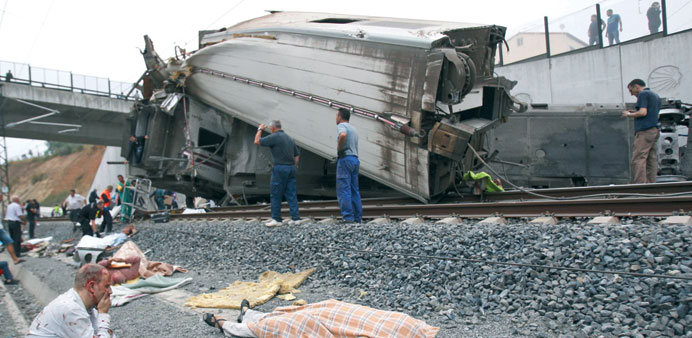
A picture taken on Wednesday shows an injured man sitting next to the body of a victim covered with a blanket following the train accident.