


AFP/Dhaka
Bangladeshi police have arrested the mayor of the town where a garment factory block collapsed killing 1,129 people, for his role in approving the shoddy structure, an officer said yesterday.
Mohammad Refayet Ullah, the mayor of Savar, was arrested in the capital late Wednesday exactly three months after the Rana Plaza building collapsed in one of the world’s worst industrial disasters.
Local police chief Mostofa Kamal said Ullah, who was suspended as mayor in the wake of the tragedy, had been wanted for questioning over the nine-storey structure, housing garment factories, that flouted building codes.
“CID (Criminal Investigation Department) officers who are probing the case arrested him from Dhaka,” Kamal said.
Ullah, an opposition official who for the last 14 years has been the mayor of the satellite town outside the capital, home to scores of garment factories, is the highest official to be arrested over the disaster.
Officials have said his office allowed three extra floors to be added to the building, which only originally had permission for six. His office then failed to take action when cracks appeared in the overburdened structure, one day before the tragedy.
A government team investigating the disaster, which has inspected the site, has said contractors had used shoddy construction materials to build the floors.
Heavy generators had been placed on the upper floors, so that factories could keep churning out clothes for Western retailers during power cuts, in violation of the country’s construction laws.
More than a dozen people, including the owner of the building and the owners of four factories housed there, have been arrested over the disaster, which highlighted appalling safety conditions in Bangladesh’s 4,500 garment factories.
Although the investigation team has suggested that the owners and those who abetted the building construction be prosecuted for culpable homicide, police have not yet pressed final charges against them.
The April 24 disaster has prompted the US to suspend trade privileges to impoverished Bangladesh. The tragedy also drew a consumer backlash against Western retailers who buy up to 80% of Bangladesh’s $21.5bn annual apparel shipments.
Bangladesh yesterday defended its new labour laws, and said it was angry at criticism from the International Labour Organisation (ILO) which called the legislation inadequate.
Parliament passed the legislation last week in the wake of a garment factory disaster in April that killed 1,129 people, highlighting poor safety standards in the industry.
Lawmakers said the new law ensured “full trade union rights” for millions of labourers, as it scrapped previous provisions requiring factory owners to approve the formation of a union.
In a statement issued on Monday, however, the ILO said that the law fell short of “several important steps called for” by the organisation, notably related to restrictions on workers’ freedom of association.
The law stipulates that workers can only form a union if 30% of employees approve of it in advance.
Yesterday Bangladeshi officials told a press briefing that Dhaka had vented its anger at the ILO over the public criticism.
“We’ve protested,” Labour Minister Rajiuddin Ahmed Raju said. “It’s not acceptable. We’re writing a letter seeking explanation as to why this kind of statement was issued.”
Bangladesh, the world’s second largest garment exporter, has been under intense international pressure to overhaul labour laws since the April 24 tragedy, one of the world’s worst industrial disasters.
The garment industry, which relies on cheap labour to keep itself competitive, is the mainstay of the economy, making up 40% of its industrial workforce and 80% of its $25bn annual exports.
The US last month cancelled a trade privilege for Bangladesh, alleging that it had not done enough to ensure workplace safety.
There was no immediate reaction from the US or the European Union, who together account for some 80% of Bangladesh’s $21.5bn garment exports, to the new law.
Washington last week outlined an action plan for Dhaka to restore the privilege, saying it should implement new laws that offer freedom of association and collective bargaining.
Raju defended the requirement for 30% of the workforce to approve formation of a union.
“If you don’t have support of 30% of the employees, you don’t have any right to form a union,” he said.
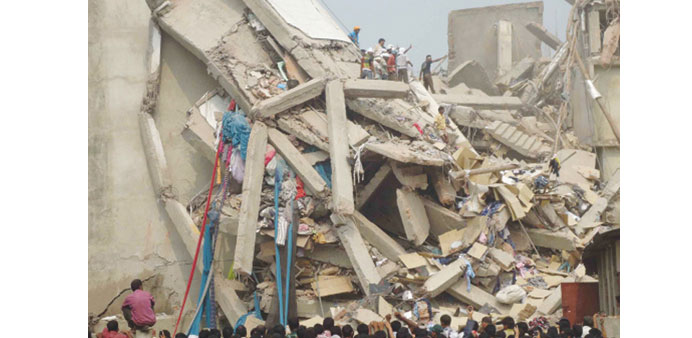
The collapsed structure.