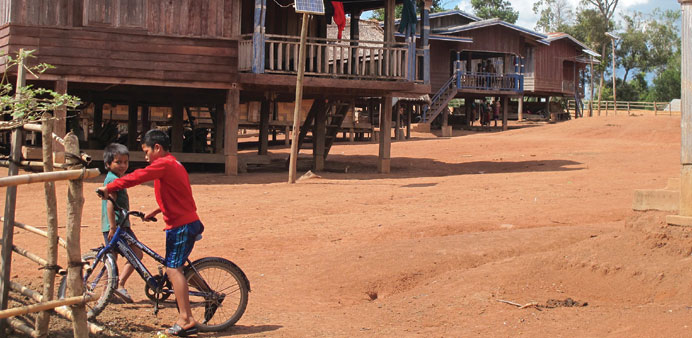
A Sunlabob solar panel is fixed to the front of the house, centre, in Bong Nam. The village children play in the red dirt. Bong Nam is entirely built on stilts.
By Christiane Oelrich
Keo Noy’s days in the 300-strong Laos village of Bong Nam on the jungle’s edge used to be pretty much over at nightfall. With no link to the electricity grid, sparse light from kerosene lamps was all that she had.
Now Noy illuminates her family’s wooden hut with an electric lantern whose batteries are recharged at a solar-powered charging station. Not only does this techy solution provide renewable energy without waste products, it also creates jobs.
The villagers run the charging station themselves, and families pay a small fee to have their lanterns recharged. The money remunerates the “light masters” who maintain the charging station and solar collector, with a portion set aside for eventualities such as repairs or battery replacements.
“I come for recharging at least three times a week,” said Noy, a 40-year-old mother of seven children aged 2 to 21 years. “We can scarcely imagine evenings without light anymore. Sometimes we did the washing-up by the light of kerosene lamps, but we actually always go to bed early.”
Noy’s children now have enough light in the evening to do their homework. In the view of the United Nations, electrification is a key to alleviating poverty. Some 1.4bn people, or 20% of the world’s population, live without electricity. Many poor countries such as Laos are still years away from connecting remote regions to the power grid.
Home to 52 families, Bong Nam lies 200km east of the town of Pakse in the sparsely populated southern part of Laos. On a recent day, a few village boys were kicking a battered ball from one wooden hut to another. The homes are sparely furnished and stand on stilts over reddish clay soil. Many of the adults work in the fields.
Poey, who looked to be about 50 years old, stood in her doorway with a long bamboo pipe and regarded the visitors with interest. There were a few shelves along the wall of her hut, a clothing rack and a central, open fire. The family sleeps on the floor on mats, which are rolled up in the daytime. It was rather dark.
“My lantern is at the charging station,” she explained.
There is little money to be made in Bong Nam, where people live from hand to mouth.
When the harvest is good, they sell eggs or vegetables. Bong Nam and villages like it are not exactly at the top of the government’s list for electrification, so smaller, local, affordable solutions are needed.
“Achieving sustainable energy for all is not only possible, but necessary. It is the golden thread that connects development, social inclusion and environmental protection,” said UN Secretary-General Ban Ki-moon last year.
Electric lanterns and solar-powered battery-charging stations were the brainchild of Andy Schroeter, an electrical engineer and native of Hamburg, Germany. The Pico lantern that he uses — “a multifunctional mobile or stationary lighting device” — is made by the German company Phocos.
Schroeter came to Laos in 1995 with his wife, a development aid worker. Travelling through the country, he saw bitterly poor villages without electricity. In 2000 he founded Sunlabob Renewable Energy, a Laos-based company specialising in renewable energy and clean water solutions throughout the developing world.
The entrepreneur experimented with lamps of many kinds. The first prototypes resembled mine lamps; not so the Pico lanterns, which are bright orange, equipped with a high-efficiency LED and look like oversized flashlights.
With a robust, shock-resistant housing that is sealed against water and dust, they can withstand the damp jungle climate. “Wonderful,” is the assessment by Noy, who has no complaints about the design.
While there are less expensive solar-powered lamps on the market, they are often unsuitable for the jungle. Broken lamps end up in the rubbish and have to be replaced.
A virtually indestructible Sunlabob Pico Lantern costs €48 (about $61), which is unaffordable to poor villagers. So Sunlabob projects require a start-up donation. In the area of Bong Nam and six surrounding villages, the German embassy in the Lao capital Vientiane donated €10,000 (about $12,800) for seven charging stations with 50 lanterns each.
The charging stations and lanterns belong to the villages; the villagers pay only for the light. “We wanted to show that sustainable business models can be developed for the poorest of people, too,” said Schroeter, who tinkered with his model for a long time.
Noy, who manages her family’s finances, saves a quite a bit lot of money with the electric lantern.
“A single recharging costs 1,000 Lao kips,” or less than 10 US cents, and provides 55 hours of light, noted light master Nyot Many. “The kerosene that we previously bought cost 10,000 kips a litre, which lasted for about 13 hours.”
Noy spends the savings on food for her family. “Now I buy fish sauce,” she said. “And flavour enhancer,” a white power regarded as a luxury item in Laos. “I also set a little money aside in case someone becomes ill.”
The light master, in whose house the small charging station is located, also profits. During a reporter’s recent visit, he was recharging two lanterns. “There are 50 lanterns in the village. We recharge them about 350 times a month,” he said. That comes to 350,000 kips, or about $45 a month, half of which he shares with three colleagues who take turns running the station. The other half goes into a reserve fund, a record of which is kept in a red ring binder open to everyone in the village.
Sandwiched between Thailand and Vietnam and also bordering on Myanmar and China in the north and Cambodia in the south, Laos is one of the world’s poorest countries.
Its Communist government is succeeding only gradually in improving the lot of the Southeast Asian nation’s 6.3mn inhabitants. In 1992, 45% of the population were living below the poverty line, a figure that decreased to 27% by 2008.
The government aims to supply about 85% of the population with electricity by 2015. With assistance from the World Bank, it provides interest-free loans to poor families so that they can connect themselves to the power grid. They have to live in the vicinity of a power line, however, and the loans have to be repaid.
Schroeter’s idea has proven itself. There are already similar village-managed charging stations in Uganda and Tanzania, and Sunlabob has installed 70 stations with 3,500 lanterns in villages in Micronesia.
Profit-oriented but with a social conscience, the company, which has a staff of 70, has received awards from the World Bank and United Nations Development Programme. Sunlabob also builds solar stations for the World Bank, Asian Development Bank (ADB) and companies wanting to show corporate social responsibility by making a contribution to sustainable development near their factories or mines.
Not far from Bong Nam, for example, the ADB financed a Sunlabob solar station that supplies electricity for a freezer at a health care centre. “We can now store vaccine,” said Kham Many, a physician at the centre. “When I ordered serum before, it came in cooler bags and I had to use it up within two days. Children could only be inoculated when the next batch came. Now we’ve got everything we need in stock.”
He added that he now saw far fewer patients — not only because of the inoculations, but also the electric lanterns. “A lot more people used to come with a cough from the smoke of the kerosene lamps,” he said.
Noy knows the problem well. “Since the lamplight was so dim,” she said, “you had to decide whether to come up very close — and get a black nose and start coughing — or to not see much.”
The kerosene lamps were dangerous as well. “My house burned down four years ago,” related light master Am Mawn, who said his children had been home alone when the lamp suddenly tipped over. “All of them got out, though.”
The inhabitants of Bong Nam are now considering ways to use electric light in the evening to earn more money, for example with handicrafts. — DPA