


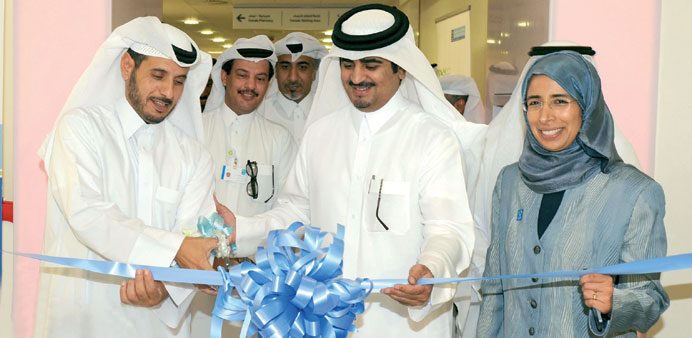
HE the Prime Minister and Minister of Interior Sheikh Abdullah bin Nasser bin Khalifa al-Thani inaugurating the National Centre for Diabetes Treatment at the Hamad General Hospital yesterday.
A world-class treatment centre that will provide Qatar’s diabetic population with improved patient care and access to specialised services through a multi-disciplinary approach was opened at the Hamad General Hospital yesterday.
The opening ceremony of the National Centre for Diabetes Treatment was led by HE the Prime Minister and Interior Minister Sheikh Abdullah bin Nasser bin Khalifa al-Thani, the Minister of Public Health HE Abdullah bin Khalid al-Qahtani and Dr Hanan al-Kuwari, managing director of Hamad Medical Corporation (HMC).
The diabetes centre is located on the second floor of the outpatient department.
“The family-centred facility offers diabetes treatment through an interdisciplinary team approach,” said al-Kuwari.
“This is the first in a chain of diabetic care centres across HMC hospitals that will serve as ‘one-stop shop’ in which patients can speak with specialist doctors and nutrition experts, renew prescriptions and learn about how to manage their condition,” added al-Kuwari.
Following the ribbon-cutting ceremony, the dignitaries toured the new centre, which is the first of its kind in Qatar. The centre will serve as a model for a multi-disciplinary approach to caring for diabetics and is an example of HMC’s focus on integrating education and research with clinical care.
Treating patients during morning and early evening clinics, the new facility includes a range of services, including foot care, counselling, blood investigation and insulin pump therapy.
Approximately 20,000 patient visits are expected at the facility this year.
The centre will also house research teams who are studying evidence-based strategies for the treatment and prevention of diabetes and its complications.
“The new diabetes centre will serve as a model for the effective care of complicated cases,” said Prof Abdul-Badi Abou-Samra, chair,
Department of Internal Medicine.
“By creating seamless access to services and specialists and supporting targeted clinical research, the diabetes centre will improve patient outcomes and play an important role in caring for the children and adults of Qatar who are living with diabetes,” said Abou-Samra.
Diabetes is a complex condition which can lead to debilitating long-term complications and acute illness. The disease has reached epidemic proportion in Qatar with about 17% of the the state’s adult population thought to have diabetes.
About 11% of Qatar’s population is considered to be pre-diabetic. Also, approximately 10% of pregnant women in Qatar have diabetes. But it is estimated that as many as a third of diabetics are not aware of their disease.
Colene Daniel, chief executive officer of Hamad General Hospital, said the new facility was part of HMC’s approach to managing the current and future demand for its diabetic services.
“The diabetes centre is part of Hamad General Hospital’s ongoing commitment to ensuring that our patients get the care they need, when they need it. It is a tangible example of our approach to a more collaborative relationship between clinicians and patients,” said Daniel.
In the coming months HMC will launch an awareness campaign designed to increase public understanding of diabetes.
The campaign will highlight strategies to manage and prevent lifestyle-related chronic diseases such as cardiovascular disease.
With recent statistics suggesting that over 70% of the population is overweight, raising community awareness of healthy lifestyle practices is a vital strategy for reducing the incidence of type 2 diabetes in Qatar.
After the inauguration of the centre, the VIP guests toured some of the other facilities at Hamad Medical Corporation, including the newly-established Supreme Council of Health (SCH) office for the issuing of electronic birth certificates. The office will facilitate the registration of newborn babies. It allows for the issuing of an electronic birth certificate, in both private and governmental hospitals, in less than 60 minutes after completing the required form.
The Minister of Public Health emphasised that the new service was part of SCH’s continuous efforts to fulfil the National Health Strategy’s objective of providing “a comprehensive healthcare system” for everyone.