


|
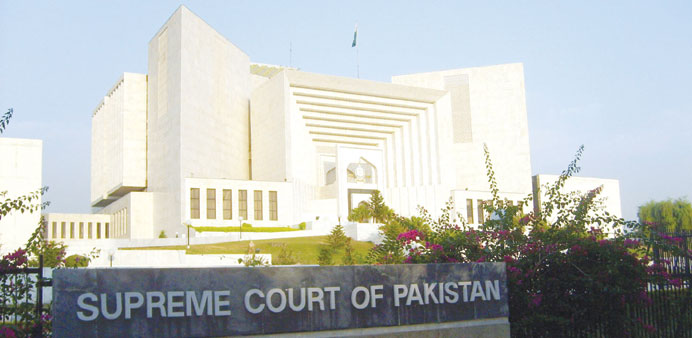
It is a measure of the authority wielded by the superior judiciary under chief justice Iftikhar Chaudhary that the Election Commission of Pakistan last week rejected a request by the federal government to postpone the presidential elections due on August 6, explicitly saying that it would do so only if the Supreme Court ordered it. |
There is a strong perception that the judiciary is continuing to “interfere” in the business of executive after it disallowed the postponement of local bodies polls. That it appeared to be in overreach during five tempestuous years of the Pakistan People’s Party (PPP) government would, perhaps, be an understatement.
But then, there was bad blood between the sitting president and the top adjudicator going back to the time when as a presiding judge he did not lend a sympathetic ear to Asif Zardari’s travails, including a lengthy incarceration over what he claims were politically motivated charges.
In a twist of fate, the-then military ruler General Pervez Musharraf sacked Chaudhry and his brother judges in late 2007 under a sweeping Emergency rule, and subsequently, Zardari rose to lead what then was the country’s largest political force following the tragic assassination of his spouse and former prime minister Benazir Bhutto.
Eventually, Zardari became president and reneged on Bhutto’s promise to reinstate Chaudhry for a good year before a popular revolt led by the lawyers and current prime minister Nawaz Sharif forced his hand. Since then, the superior judiciary became unsparing of the PPP’s government and sacked its prime minister last year when he failed to comply with its directives to write a letter to the Swiss authorities to reopen previously quashed cases against the president.
The Chaudhry-Zardari cold war makes for a compelling story although fear of the gavel prevents most Pakistani commentators from delving too much into the contours of a decidedly personal conflict.
The PPP has long accused the Chaudhry-led judiciary of bias in favour of Sharif and his Pakistan Muslim League (PML-N). Even though the apex court has been relatively quiet in what is a honeymoon phase for the Sharif government, it hasn’t compromised on its cutting edge as probably the most powerful institution/stakeholder after the military.
To its credit, it hasn’t exactly been soft on the military either, having set precedents by convicting a former army chief, General Aslam Beg, of conspiring to prevent the PPP from coming into power in 1990 by bribing key figures of the opposition, and has since ordered to try another ex-strongman General Musharraf for treason - which upon conviction carries capital punishment.
Last week, it also directed the provincial governments to hold local bodies polls by September 15 against the wishes of both the ruling PML-N and its predecessor, PPP.
The two parties have long dithered over what is a constitutional obligation under Articles 32 and 140-A. The LB polls, as they are called, have to be conducted within three months of the general elections.
In fact, LB polls have not been conducted since 2002; the PPP came into power in 2008 and completed its five-year term in March this year. The general elections were held on May 11.
Why are the LB polls significant and the two mainstream parties a trite edgy about these?
In Pakistan’s system of governance, local governments have a strong base, and mandatorily require devolution of power — something of an anathema for the likes of PML-N and PPP.
Technically speaking, a local government is only a third tier of governance after the federation and the provincial governments, but we are talking roots here. There are three types of administrative units of the local government, namely District Government administration, Town Municipal administration and Union Council administration.
The elected councils are headed by a Nazim - Urdu for supervisor, or the equivalent of a mayor. According to the nomenclature, districts with large metropolitan areas are called City Districts. A City District may contain sub-divisions called Towns and Union Councils. District Governments have a District Co-ordination Officer (DCO), who is a civil servant in charge of devolved departments. At present, the powers of a Nazim are held by the DCO.
Coming back to the view that the judiciary uses a heavy hand even in domains whose functions are strictly executive in nature, the fact is it is not always a case of what you see is what you get.
While it holds that the ambit of the judiciary lies strictly in interpreting the law, the same law stipulates that the government(s) must hold LB polls within three months of a general election.
The fact is that it has not been held on the pretext of a non-conducive law and order situation since 2002 whereas two federal and provincial elections have been conducted in the interim with not a murmur for putting them off for the same reason.
PML-N and PPP have been reluctant to hold the exercise also because candidates at this level do not necessarily owe their allegiance to the party to win an election. Rather, it is down to purely local interest where the more a candidate has a powerful clan base and is networked to the locals, the more his/her chances of making the cut.
And so even though PML-N rules the roost in the Punjab legislature, it may still face tough competition from the likes of rival Imran Khan’s Pakistan Tehreek-i-Insaf (PTI) and Jamaat-e-Islami - especially, if the last two decide to contest the LB polls jointly.
Even Pakistan Muslim League-Quaid has a strong local presence thanks to their successful stint during the Musharraf years.
Similarly, even though PPP has a stranglehold on the Sindh legislature, it will not only have to contend with MQM’s powerful local base, but the new kid in town, PTI, too, which can be expected to reap the fruits of its bold showing in last May’s election, where urbanites stunned the pundits with their resolute backing of the party.
So far, both the PML-N and PPP provincial governments have requested the Supreme Court to give them more time, but the PTI government in Khyber-Pakhtunkhwa province - ironically, the more contentious of the four provinces in terms of the law and order situation - and Balochistan, which is also restive, are willing to go ahead with the vote.
Given the multifarious challenges of governance facing Pakistan, it makes sense to go to the hustings soonest and have local governments, more tuned in with issues at source, in charge.